

A conversation with Nick and Lins of Naked Wanderings
The Belgian travel writers on how years on the road changed their views of naturism—and when to put the camera down.
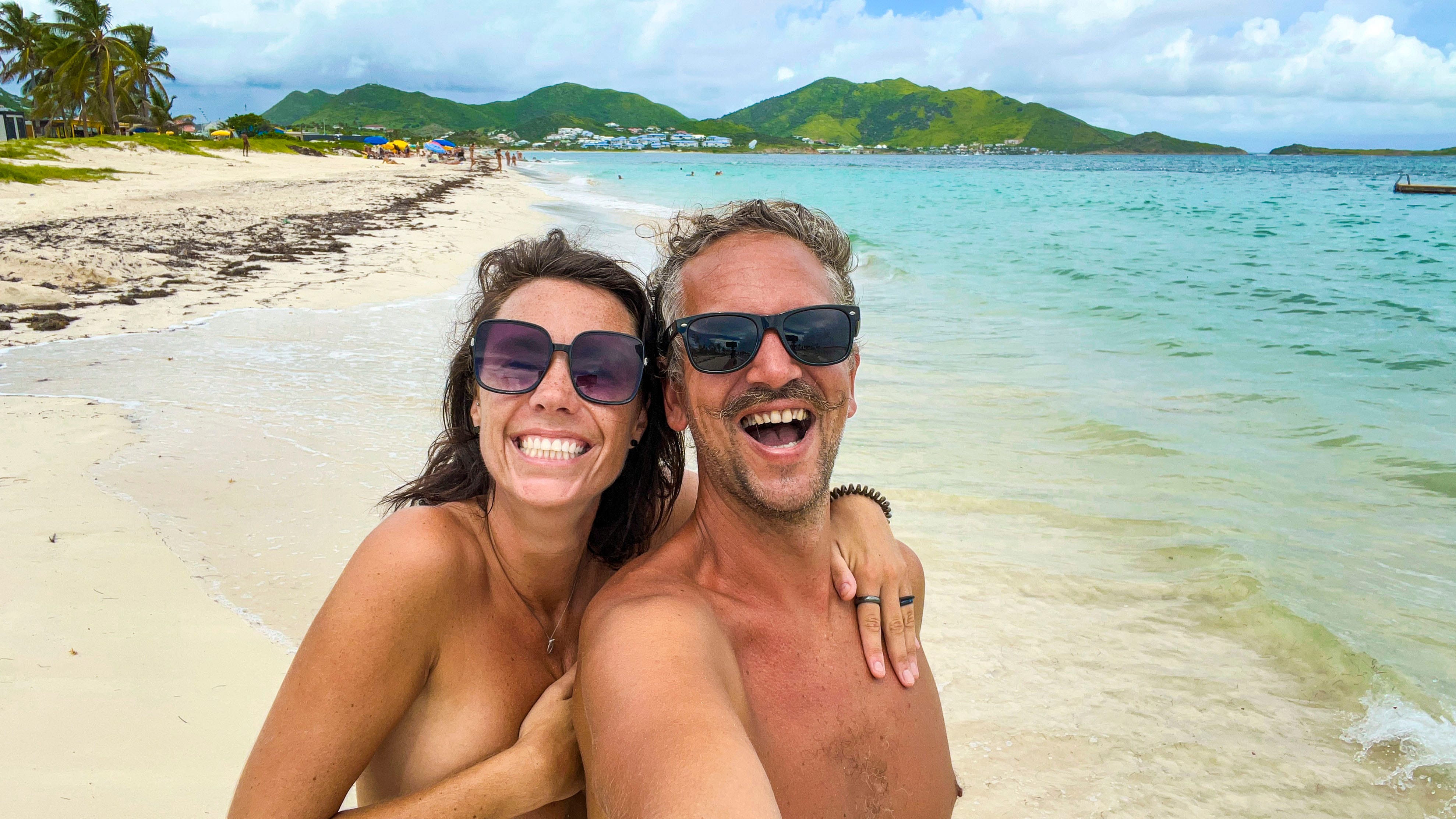
Nick and Lins left Belgium in July 2017 with two backpacks and one-way tickets to Croatia. They had saved enough for about two years of travel. More than nine years later, the couple behind Naked Wanderings is still on the road, documenting places where clothes are optional.
Their work now spans several formats. The Naked Wanderings blog combines travel accounts with commentary on naturism. On YouTube, Nick & Lins follows their travels, while Destination Clothes Free offers guides to resorts and beaches. This year, they launched a Destination Clothes Free newsletter to help readers plan their own trips.
Their latest project, Naked Without Cameras, is a podcast recorded after clothes-free experiences, while the details were still fresh. Announced on October 21 and currently available only on Patreon, it offers another way to tell stories from their travels. They are also preparing to host trips in South Africa in 2027 with tour operator Joxilox.
Alongside their own publishing work, they have participated in International Naturist Federation congresses as delegates for national federations—which is how I finally met them in 2024, in Zipolite. I recently sent them an handful of questions over email about the work behind their projects and what years of travel have taught them about naturism. They chose to answer together, as they usually do in their work.
Answers by Nick & Lins, Oct. 2026
What has surprised you most about naturism since you began Naked Wanderings?
In one word: Variety. First of all, the variety in opportunities. When we started Naked Wanderings, we believed that naturism was centred around beaches and campsites (and to a small extent saunas). Very early on, we got invited to a naturist hotel in Greece, and that was an eye-opener. Wow, this too is possible. The further we looked, the more the offer grew. Mega resorts, boutique hotels, guesthouses, cruises… Only when we visited the USA for the first time, we learned about non-landed clubs and the variety of activities they organise.
Then there was the variety in people. The cliché that the naturist is white and middle-aged still stands, but a summer in France or Croatia will show you that the spectrum is much bigger than that. We’ve spent time with a black naturist group in South Africa, Latino groups in Brazil, Mexico, and Colombia, and Asian groups in Thailand. They all share the same foundations and values. Many naturists we meet work in public service (teachers, healthcare, etc), but we’ve equally met CEOs and fashion designers. We often tell the story about how we once had breakfast in a naturist resort sharing the table with Christians, Muslims, Buddhists, and Hindus.
Literally everyone can be a naturist, and there’s also a variety of reasons behind it. For us, at the beginning, the biggest trigger was the “out of your comfort zone” element. We are both very curious and are continuously looking for what else is out there. Naturism was a great spark because it was covered with a blanket of ignorance and taboo. As soon as we tried it, the comfort element came in. When camping or swimming, not having to consider clothes increases your comfort a lot. Think walking around in wet bathing suits, shower stalls with not enough hooks, trying to get dressed in a small tent. All these minor annoyances just disappeared. And then came the community element, it felt like we could connect to people on a much more honest level when everyone is naked. By talking to other naturists, many other reasons showed up. For some, it helped conquer body issues or traumas from being raised in ultra-conservative families. Things we could not 100% relate to, but made total sense.
Which experience abroad most challenged your own idea of what naturism should look like?
We often say: If you would read Naked Wanderings as a book, from the first blog post to the last one, it probably won’t make much sense. We continuously change our idea of what naturism should or could look like. We don’t think that there has ever been a defining epiphany. What shaped our views and visions is the 10-year-long journey and the people we met along the way. A good example is the process of how we evolved from being huge critics of organised naturism to being actively involved in it, but we’ll get to that later. We changed our opinions about quite a few controversial topics as well, for example, adults-only naturist resorts. At the beginning, we believed that all naturist resorts should be family-oriented, and if they are not, there must be some hidden reason. But from visiting adults-only resorts and talking to the people who stay there, we learned that there are many reasons to go there. If you’re a teacher and spend your days in front of twenty kids, it’s not that hard to understand that you may want to avoid them during your holidays. Some people just don’t like children. Some find it not okay to drink alcohol in front of children. Some feel uncomfortable being naked around children (which seems to be a growing thing in the USA), and so on.
The same for single men policies. We always believed that nobody should be discriminated against and that everyone should get a chance, and we still do. But after talking to resort owners and people who have been harassed, we’re much more reluctant to blindly sign a petition without hearing all parties.
For someone who’s comfortable naked at home but curious about a social setting, what matters most when choosing that first place?
Probably the most important thing is to ask yourself what you’re looking for in the experience and what would match your likes in general. If you’re looking for the social element, beaches or mega resorts are not the place to be. Better aim for smaller resorts that have community activities. If you don’t really like camping, you probably won’t really like naked camping either, so better look for something more upscale. When writing this down, it all feels so logical to us, but still we’ve met quite a few people who didn’t have the best first experience just because they didn’t go to the right place. So spend time reading blogs and reviews and ask yourself whether this could be the right place for you. Also know that there’s a big difference between resorts and beaches, in the sense that resorts have a level of security that beaches just can’t offer. A while ago, we received a message from a woman who wanted to try naturism while on a trip to Italy and asked for recommendations for nude beaches. While Italy has some great nude beaches, most have a few weird people hanging around. That’s not what you want someone to have to cope with during her first naturist experience. So we recommended her a small resort that does day passes instead.
She went, she enjoyed it, and she will seek out more naturist places in the future. If her next destination is a nude beach and she doesn’t enjoy it, at least she knows that there are alternatives she does like. Which brings us back to what we said earlier: If your first experience wasn’t an ideal one, that doesn’t mean that you don’t like naturism. Think about what you did and didn’t enjoy and look for better places from there.
You’ve visited everything from small clubs to large resorts. What makes somewhere feel genuinely welcoming?
We spend a lot of time at large, commercial resorts, and there, we like the normality of it all. You book online, show up at the reception desk, and you get your key or your camping pitch assigned. Just like at any other resort. But then, last summer, we visited a few small, volunteer-run clubs in Sweden and very much appreciated the personal approach. Someone really took time to show us around the grounds, told us the direction of the sun and wind to help us pick the best place, and regularly checked up on us afterwards. Here too, it shows the importance of what you’re looking for. If you want to spend a few days of quality time with the family or as a couple, the social element can feel suffocating and continuously being invited to join activities may feel like pressure. But if your goal is to meet people, that’s exactly what you want. To us, the best places are those where you have the choice. Some resorts have a social pool and a quiet pool, for example. Or areas where they actively try to bring people together and others where they focus on solitude. This can be as simple as the way sunbeds are positioned.
A lot depends on the other people as well. Especially in resorts with residents or long-stay guests, you can sometimes sense an “us vs them” mentality. In the way that they consider the place their own and tolerate the tourists just because they know the resort needs the money. But sometimes it’s also the other way around, where it feels like the residents have all agreed to give every newcomer the best time of their lives. And sometimes you find both in one place. We remember a resort in Florida where some of the residents plainly ignored us even when we tried to get into a conversation, and other residents went out of their way to make sure we had everything we needed.
Enjoying this conversation? A paid subscription helps support more independent naturist journalism.
At Ågesta in Sweden, you put aside a planned video to spend time with the beach community. What gets left out of the online picture of naturism because it’s difficult or inappropriate to film?
The one thing we’ve been struggling with since the beginning of Naked Wanderings is that we can’t visualise the vibe and atmosphere of a place, while at some places, this is their greatest asset. Ågesta is not a mind-blowing beach on itself, it’s an okay lake with a patch of sand and a huge lawn behind it. But yet, it was one of our best nude beach experiences of the year, and that’s all because of the people and the community. And those are exactly the things we can’t film for privacy reasons. We are extremely careful with this. We obviously won’t publish any footage that contains people who didn’t give their consent, but also, we know that a lot of naturists are concerned about photography, and we don’t want them to spend their precious time worrying about us. So our approach has always been to try to stay invisible as much as possible. But, of course, this results in a lot of shots without any people but ourselves.
We struggle most with this when we’re filming resorts. We can show you what it looks like, but not what it feels like. Earlier this year, we made a video about Domaine du Coq Rouge, a naturist campsite in France. It’s a beautiful place in the forest, located on a hill with great views, they have a nice pool and lots of cool rentals. It’s a pretty easy resort to film, and we think we made a decent video out of it. But when we were looking at it after the edit, all we could think was, “This is not really Le Coq Rouge”. It looks like it, but it doesn’t reflect our experience. What made this resort memorable was that we could stop for a drink at the bar in the afternoon and still be there hours later sharing pizzas with a bunch of people we just met. At Ågesta, you could see a couple engage in a conversation with the couple next to them, and hours later there would be a circle of 25 people all chatting along.
When we started doing video, all we ever thought about was the next shot. It took us a few years to realise that we were missing out on something that has very much attracted us to naturism in the first place, the community element. So now, we try to get better at balancing. Creating content is our job and what pays for all our travels, but sometimes we really need to make the decision to put the camera down and enjoy the moment. Because when we think back about the last ten years, the memories that stuck are rarely the ones when we had a camera in our hands.
Many readers know your blog and videos but may not know about your work with INF and other naturist organizations. What does that part of your advocacy involve, and what keeps you invested in it?
Our first encounter with naturist organisations was back in the early 2010s, years before Naked Wanderings, when we had just begun exploring the world of naturism and figured that joining the Belgian Naturist Federation would help us with that. So we filled out an online form and got sent a brown envelope with a bunch of paperwork. We got stuck at the question “What can you do for the organisation?” Somehow, we figured that paying a yearly membership fee would have been sufficient. So the papers remained on the table for a while, found their way into a closet, and were never seen again. In the years that followed, we started reading websites and newsletters of naturist organisations and more and more, we started feeling like the way they pictured naturism was not at all like how we experienced it. There were endless lists of what you should and should not do, “THE naturist” was pictured as someone who felt comfortable being pictured full frontal on the internet, it was all about deeply rooted philosophies and ways of living, while we just thought it was a lot of fun and very comfortable.
In fact, this was one of the major triggers for us to start Naked Wanderings. We wanted to show what naturism looked like through our own eyes. So it’s fair to say that we started off as strong critics of organised naturism. A first breakthrough moment was when the president of the Belgian federation invited us to a work weekend at a club. A few times a year, many members got together to do all kinds of maintenance. We expected to end up with a group doing work because they have to, because it’s part of their membership agreement, but instead, we found a strong community having the best time. They worked together, ate together, drank together, shared stories and laughs. What sounded like an obligation at first appeared to be a great social event.
Later that year, we contacted the INF to see whether it was possible to participate in their biannual congress. We had been creating content about naturism and wanted to know what the great leaders were talking about. Maybe we could share some experiences. Our participation was denied by the INF board, but the president of the Belgian federation managed to get us in as guests. We could sit in a corner and were not allowed to talk. What we witnessed was a weekend of duality and hostility. There were basically 2 sides, which we called the progressive and the conservative. The former were federations that were looking for ways to modernise organised naturism and attract a wider range of people. The latter were trying to maintain a closed community purely based on membership. We remember someone saying something like “naturists have membership cards, otherwise they’re just naked people”. Obviously, we leaned more towards the progressive side. Although the congress itself didn’t exactly bring the inspiration we had hoped for, it was a great opportunity to network with the federations that shared our vision.
We would stay in touch with them and share ideas. The next congress happened during the COVID pandemic, and many federation representatives were not allowed to travel. So we were asked to represent Australia and South Africa. Now we had a seat at the adults’ table. Even after COVID was gone, the Australian federation kept asking Nick to represent them, so eventually we participated in 4 congresses, of which 3 as representatives. During these years, we learned a lot about how federations work and many of our prejudices were swept away. To us, it all seemed very obvious, and we didn’t understand why change had to take such a long time. But when you’re working with an established organisation that is representing over forty countries which each their own needs, ideas, and visions, it becomes a lot more complicated.
Back in 2018, during our first congress, we had the idea that the INF was actually working against us. While we were shouting that everyone can be a naturist, they were just adding more and more restrictions on becoming a naturist. Over the years, we’ve seen the vision of the INF evolve into something that aligns much more with our own vision, and this is what keeps us involved. Back in 2018, it was easy to criticise them from the sidelines, but the last few years have proven that if we really want to see change, we need to be part of it.
What have you learned from your international audience that could help organizations connect with people who enjoy being naked but have never joined a club?
The biggest thing is probably that naturists today often question the need for organisations. Until a few decades ago, organised naturism had a monopoly on information about naturism and naturist venues and on entrance to these venues (membership was required pretty much everywhere). The monopoly on information disappeared with the rise of the internet, and this worked in both directions. Naturists could find information without a membership, and resorts could reach potential guests without having to go through an organisation. As a result, especially in Europe, mandatory membership largely disappeared. This required organisations to pivot their strategies, which many did too late or still haven’t done. They kept believing that new naturists would just join the organisation because it’s “THE organisation”. And that didn’t really happen.
Naturists today want a reason to join. And that’s where most organisations fail. Throughout our years of working with them, we’ve seen organisations do amazing things, and then tell absolutely nobody about it. The Dutch federation understood this very early on, whenever they get involved in something, they make a big fuss about it. Additionally, they organise specific member events, and they negotiate enough discounts with venues that membership pays for itself if you travel to any of their affiliated resorts. This membership is worth something. Of course, there are people who support organisations out of ideology, and there always will be (we hope). But adding more value or at least communicating better about the value they are already bringing is the way towards growth.
For readers with limited time and money for travel, what would you prioritize in planning a naturist break?
Distance eats both your time and travel budgets, so aim for places close by. Many resorts have day passes, so you don’t actually need to pay to stay overnight, and this gives you the chance to try a few out to see which place suits you best. And try to combine naturist travel with other travels you may want to do. If you want to go to a naturist resort but your family prefers an amusement park, you can go to Cypress Cove and do day trips to Disney World. Or stay at Disney World with day trips to Cypress Cove. If money is the real issue, aim for beaches or club events.
We regularly hear that time and money are two major reasons why people don’t practice naturism more often, but it doesn’t always have to cost much or take a lot of time. It doesn’t NEED to be that expensive resort in the Caribbean, sometimes you’ll have the best time at a club around the corner. Prioritise inexpensive places and events, and you’ll usually end up with more memories and stories to tell than from a week in Mexico.
After all the places you’ve visited, what makes a good, ordinary naked day for each of you?
This is a difficult one, because we’re doing this for a living and we can get great satisfaction from getting the right shots, finding a good angle or hearing a story that we can turn into an interesting blog post. At times when we’re not working, it’s more about disconnecting. Naturist places have a tendency to put you in a bubble, away from the outside world, and we can much appreciate that. Just being there, being in the moment, enjoying time doing nothing, having real conversations with real people. Those are the good days, until we start thinking, “damn, we should have gotten this on camera.” 🙂
🪐