

Living Naked
A review of the 1993 French documentary
The future doesn’t look too bright lately in general, but for naturism, especially in the United States, it can be tough to have any real enthusiasm for the coming years. But it wasn’t always that way.
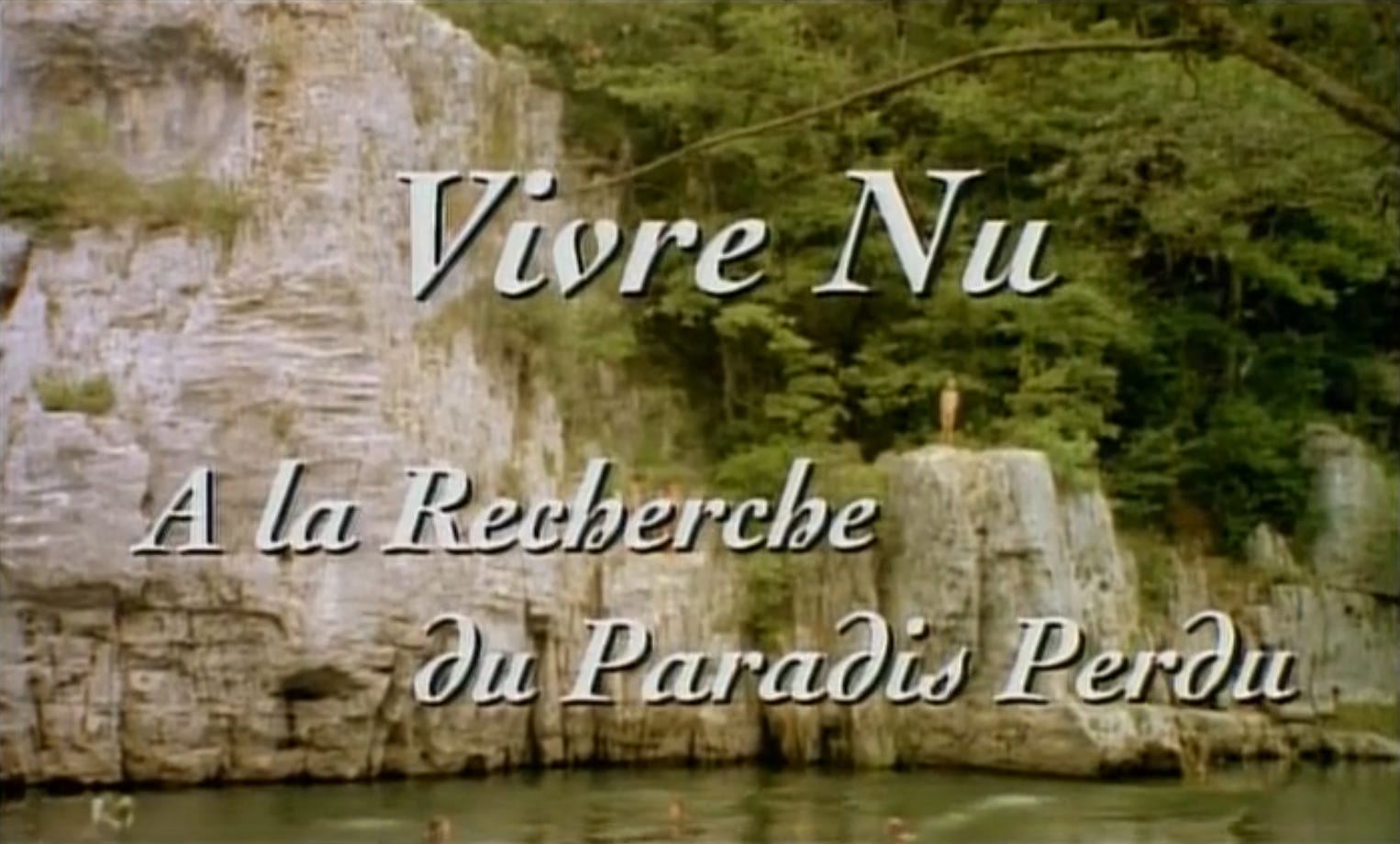
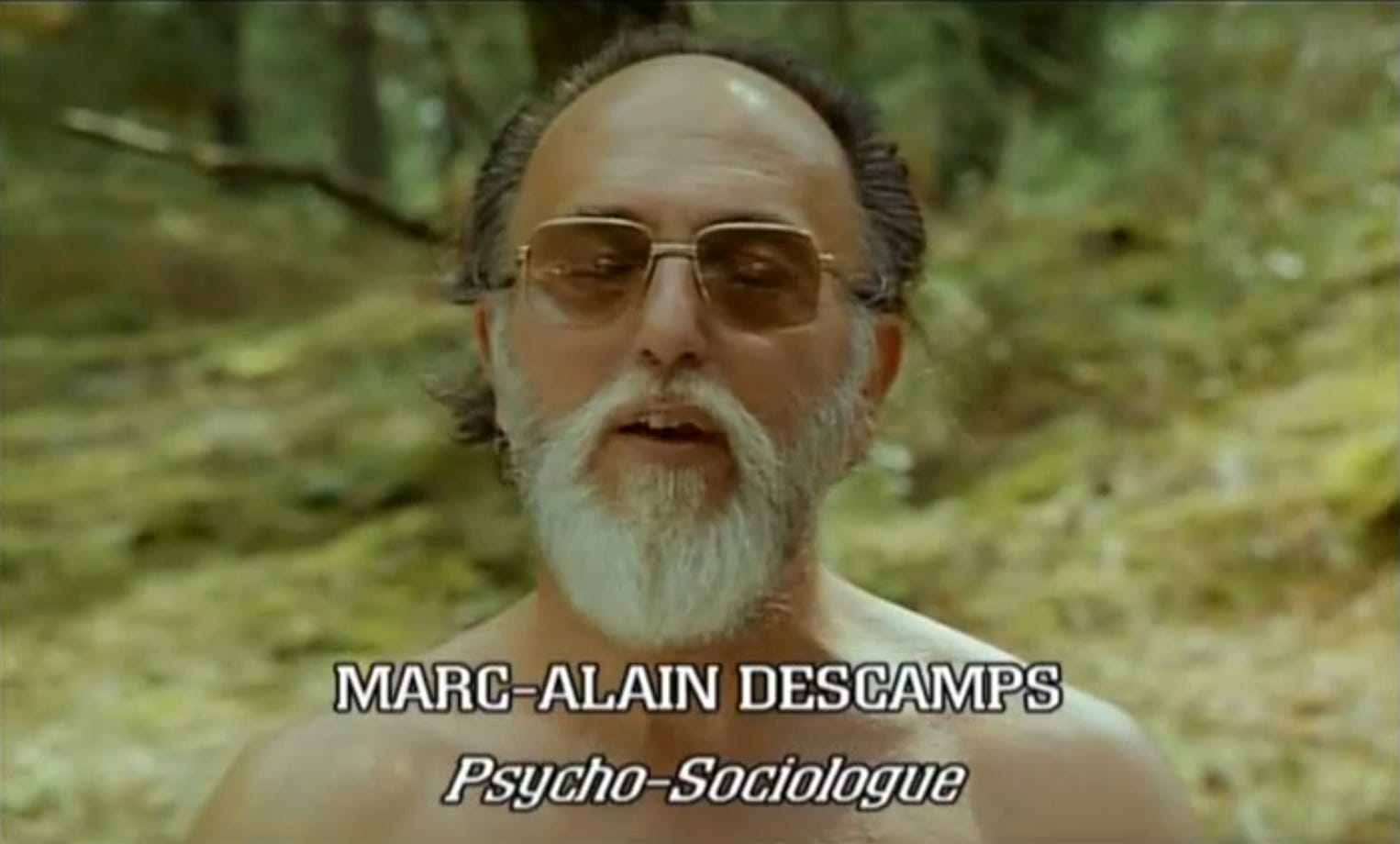
Living Nude (originally titled Vivre Nu) is a documentary from 1993 directed by Robert Salis, recently shared with English subtitles by Nude Humanity, that focuses on the naturism movement largely within France. It mainly interviews ordinary people of all ages who visit or live at various naturist sites (starting at Belezy), with one throughline being the author, psychologist, and philosophy professor Marc-Alain Descamps, who wrote a book with the same title in 1987. He’s not necessarily the guide, but it feels like this documentary was based somewhat on his book, and it’s Descamps that we cut back to more than anyone else throughout.
The documentary and its interviewees are very philosophically driven as they discuss the benefits of practicing naturism. It does feel a little bit like it starts off on the wrong foot for me personally, as very early on two young men, both eighteen, are interviewed and talk, as teenagers do, about sexual attraction. They’re explaining how naturism has made them more interested in more of an inner beauty, learning more about potential partners as whole people beyond just a simple physical attraction, but the way it happens minutes in briefly led me to believe that this is all it would be about, and well…it’s just not something I’m at all interested in. There is further discussion of sexual attraction, and it is somewhat interesting given how American nudists tend to pretend such a thing simply does not exist at all, but it also feels a little off when it’s superimposed over the footage of families and small children.
The cinematography throughout, especially early on, sometimes doesn’t help. While there is plenty of footage of families of all ages enjoying themselves in various parks, clubs, and beaches, there are times where the camera will travel across the body of a young man or woman lounging nude and it just feels leering. Genitals of interviewees are frequently, unnecessarily on display too, with shots composed that they feel more like the focus than the faces of those who are speaking. The feeling did eventually wear off as the subject matter shifted though.
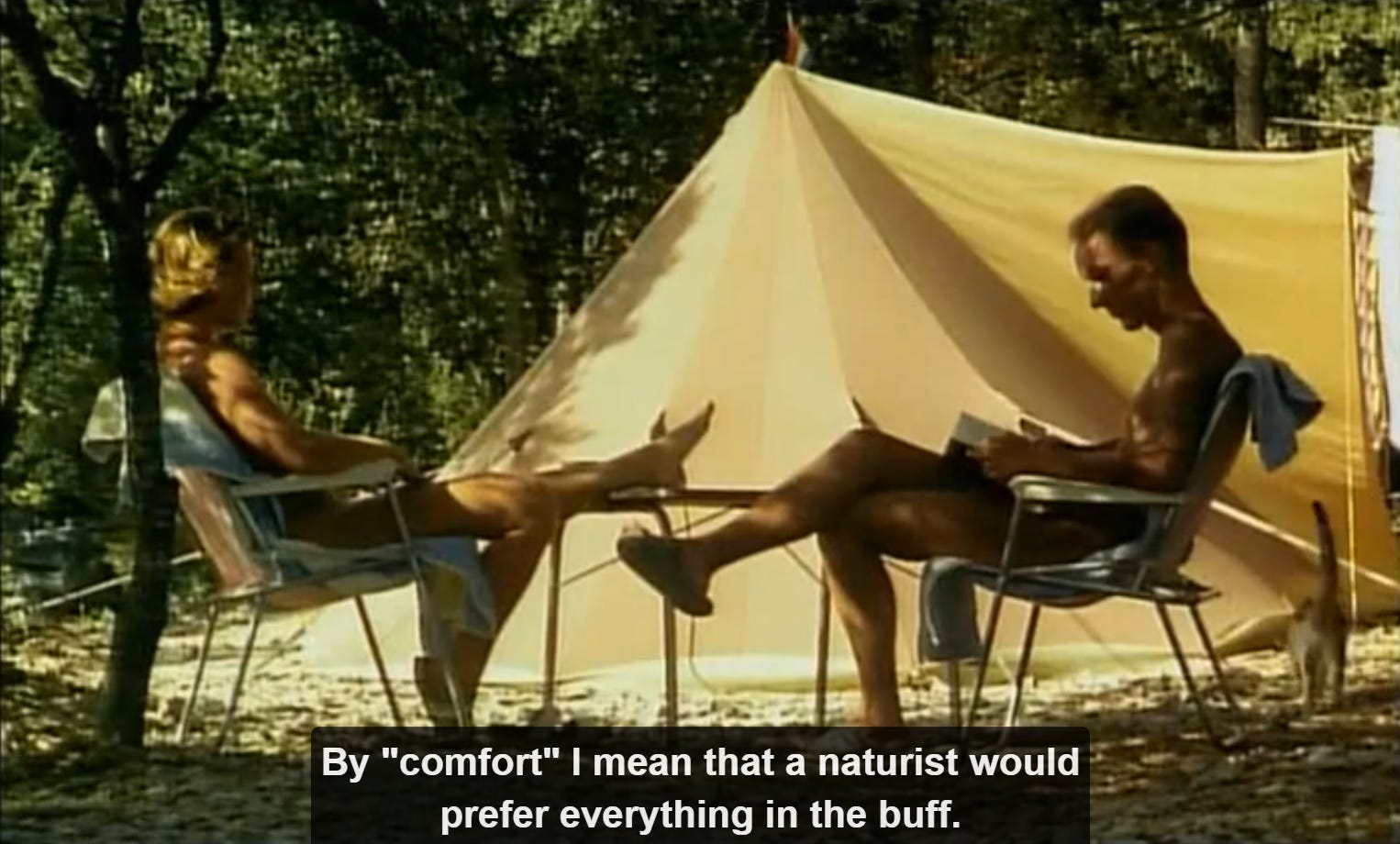
Descamps states that naturism is distinguished by three principles: comfort, shamelessness, and symbolism. Comfort is an obvious one, I think we’d all agree here that we’ve embraced nudism because we are simply more comfortable without clothes. Shamelessness is also easy to understand: we do not have, or are trying to escape from, the shame we have been taught about our bodies from an early age. Nudity is simply our natural state, there is nothing to be embarrassed about. The symbolism is the most interesting principle, as Descamps believes that nudity through naturism represents a whole set of higher values, including harmony with nature, freedom, and peace. It’s hard to argue with that.
Descamps also believes that there are three kinds of nudes: undressed, stripped naked, and voluntarily nude. Being undressed is intentionally erotic or provocative, like striptease. Stripped naked is when you’re forced to undress, made to feel vulnerable, inferior, or exploited. Voluntary nudity is more natural, with no intention behind it besides simply being nude for comfort. Obviously we fall into that latter category here.
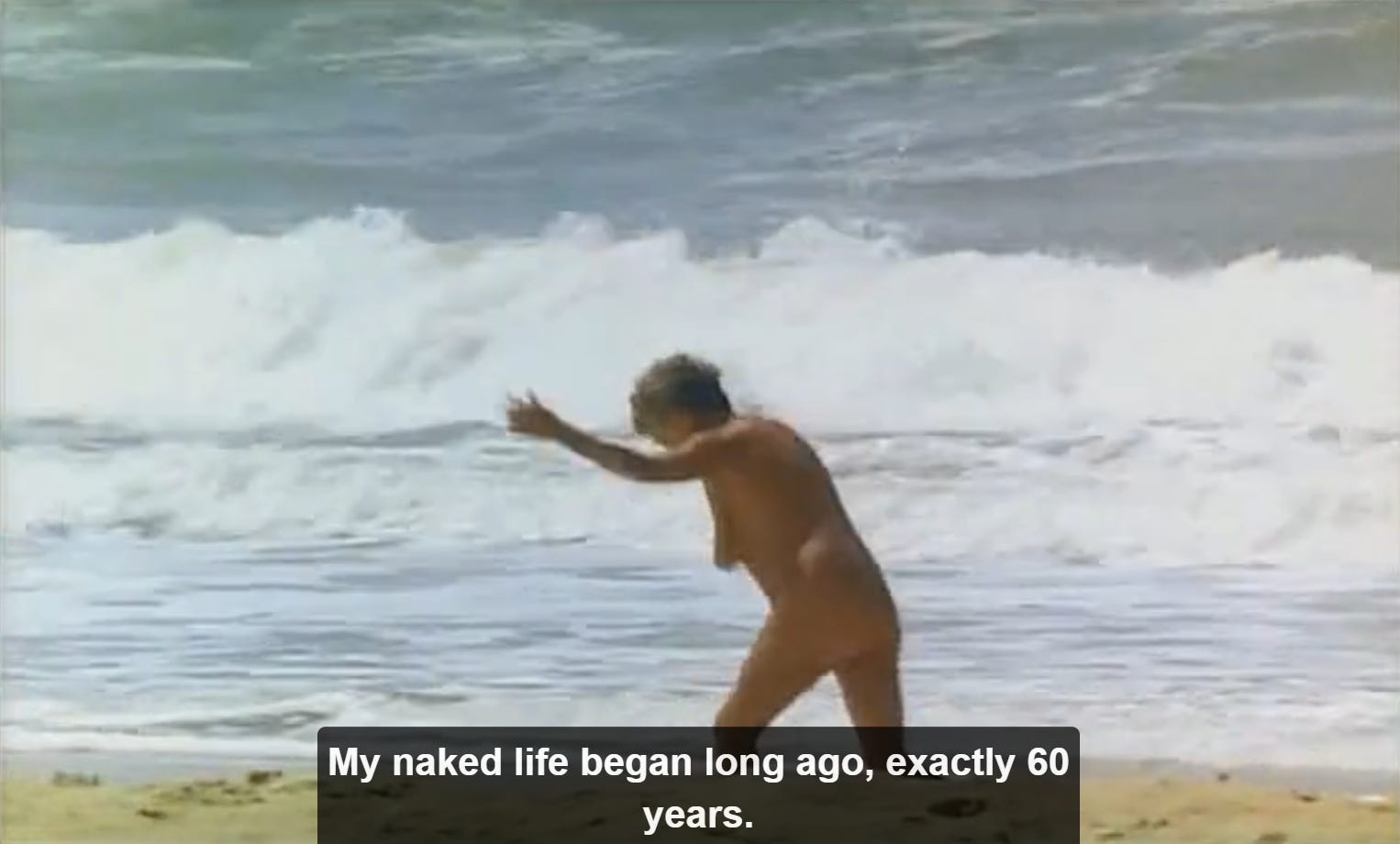
Another person of interest interviewed here is Christiane Lecoq, co-founder of the French Federation of Naturists. Seeing vintage footage of her interspersed with the interview footage of her as she approaches 81 years old and discusses being a naturist for 60 years, seeing that same smile across the decades, is lovely.
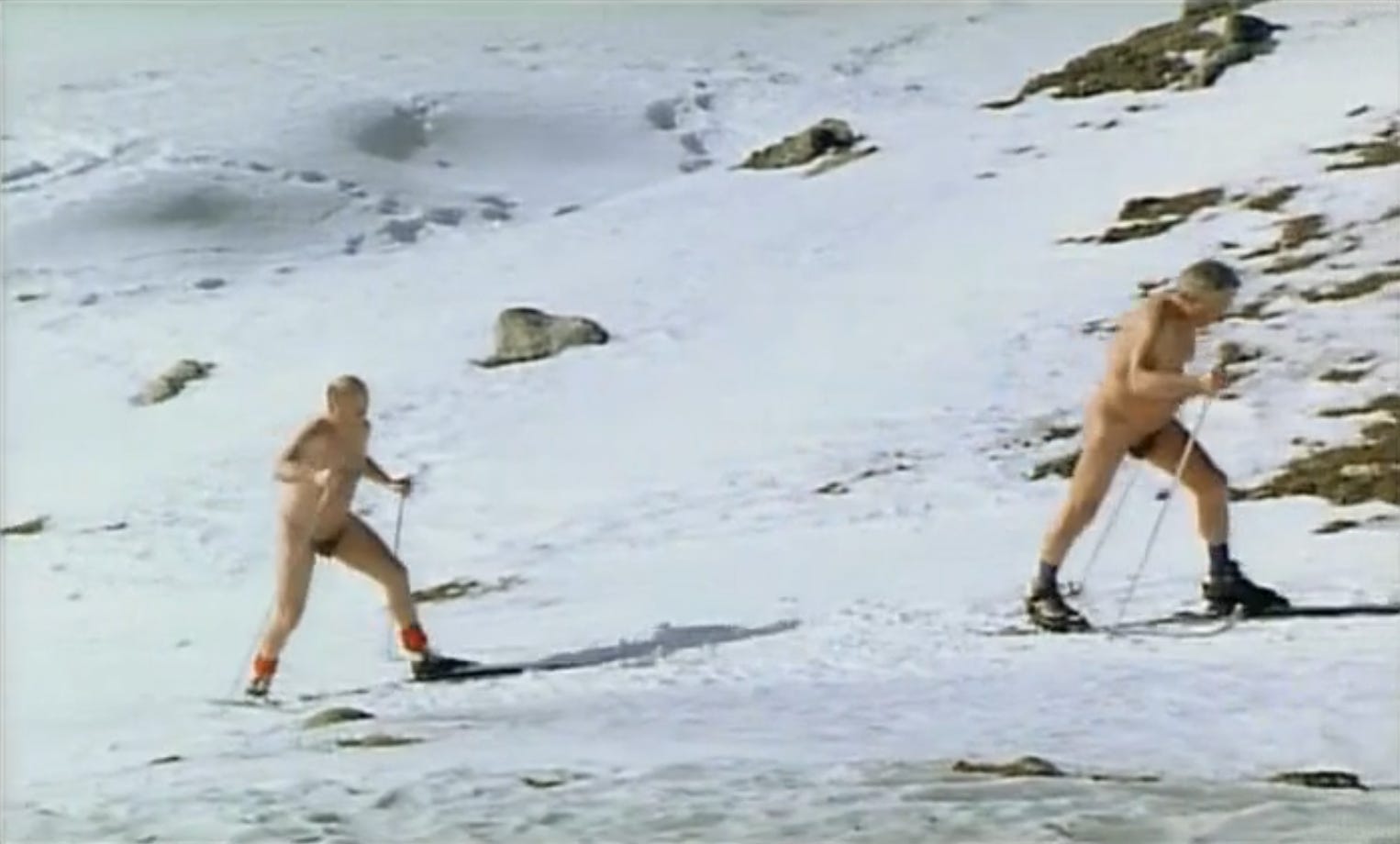
When it comes to the argument of temperature as a reason against going naked, we’re taken to Col de l’Echelle in the Alps, where nudists are seen skiing, playing, and picnicking in the cold, discussing the ways the body can regulate its own temperature. I still don’t think I have the fortitude for that myself, but it was fun seeing so much time spent here.
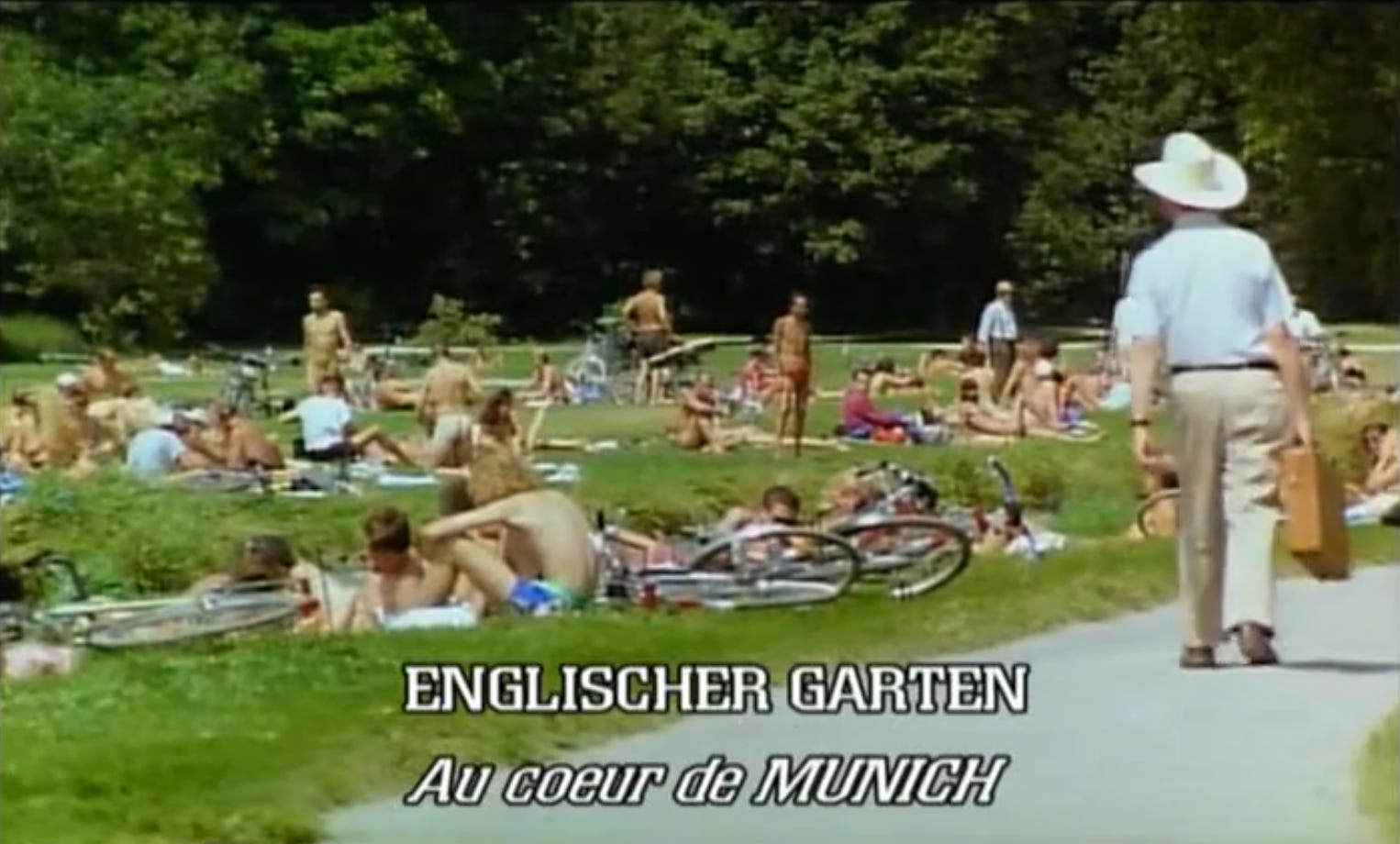
None of the arguments made for naturism are new here, but they are nicely presented, and for me that French perspective is one I’ve very rarely gotten to see. There are also scenes in Munich, Germany that are my favorite. Seeing people both clothed and unclothed lounging in parks and swimming in rivers, many coming from other countries, all relaxed and smiling, is a delight. The ideals that are spoken of throughout the documentary are seen here and everyone interviewed is so happy. I don’t know if it’s still like that there or not, but it’s definitely the kind of setting the world needs more of.
There are some other interesting interviews too: one man briefly interviewed in a wheelchair on the beach discusses his fears of leaving the lifestyle due to a lack of accommodations for his disability. I wish this was given more time, because it’s a very real issue, with certain more famous nude beaches and clothing optional being notoriously difficult to get to even for someone who’s more able-bodied. Whole families are interviewed, as well as a pair of children who ask each other questions about how they got started and whether or not they tell their teachers and peers at school about this aspect of their lives. Another man keeps referring to textiles as “hidebound,” which felt so bizarre to me, almost savage.
The translation in the version I watched can often be questionable, making interviews a little difficult to follow. There’s also a moment where Descamps mentions that it is fine to go nude publicly in Japan among other countries, a very untrue statement. What’s more, when it gets to a couple from the UK speaking English, the subtitles do not match what they say at all. The man in the couple talks about voyeuristic men who stand and gaze at beachgoers in the UK, but the subtitles for some reason refer to gay men instead. There are also some sizable chunks of dialogue that seem to not be translated at all, especially when people wind up talking over each other. Cap d’Agde is also misspelled when the signage is onscreen! I did appreciate the cover of surf rock classic Pipeline that plays when we reach the famous beach town though.
Still, even with the wonky translation (if you choose to watch with subtitles), this documentary is unique as a fairly in-depth look at French nudism in the early nineties, a time capsule from shortly before the internet became more commonplace and shifted nudism as a movement worldwide. It makes me wonder how many of the places shown are still around and functioning.
Something mentioned multiple times is the idea that nudity is democratic. As Descamps goes into the history of German nudism (I was surprised to hear about nudists being sent to concentration camps and castrated during Hitler’s reign, the latter of which I’d never heard or read before), he mentions that free nations are more comfortable with nudity while tyrants strangle the right to be nude. Nobody in Living Naked advocates for a world where everyone is naked all the time. Instead, they argue simply for the freedom to be nude if one wishes, and to encounter that in a documentary from the early 1990s was profound since it still feels to me like a new idea.
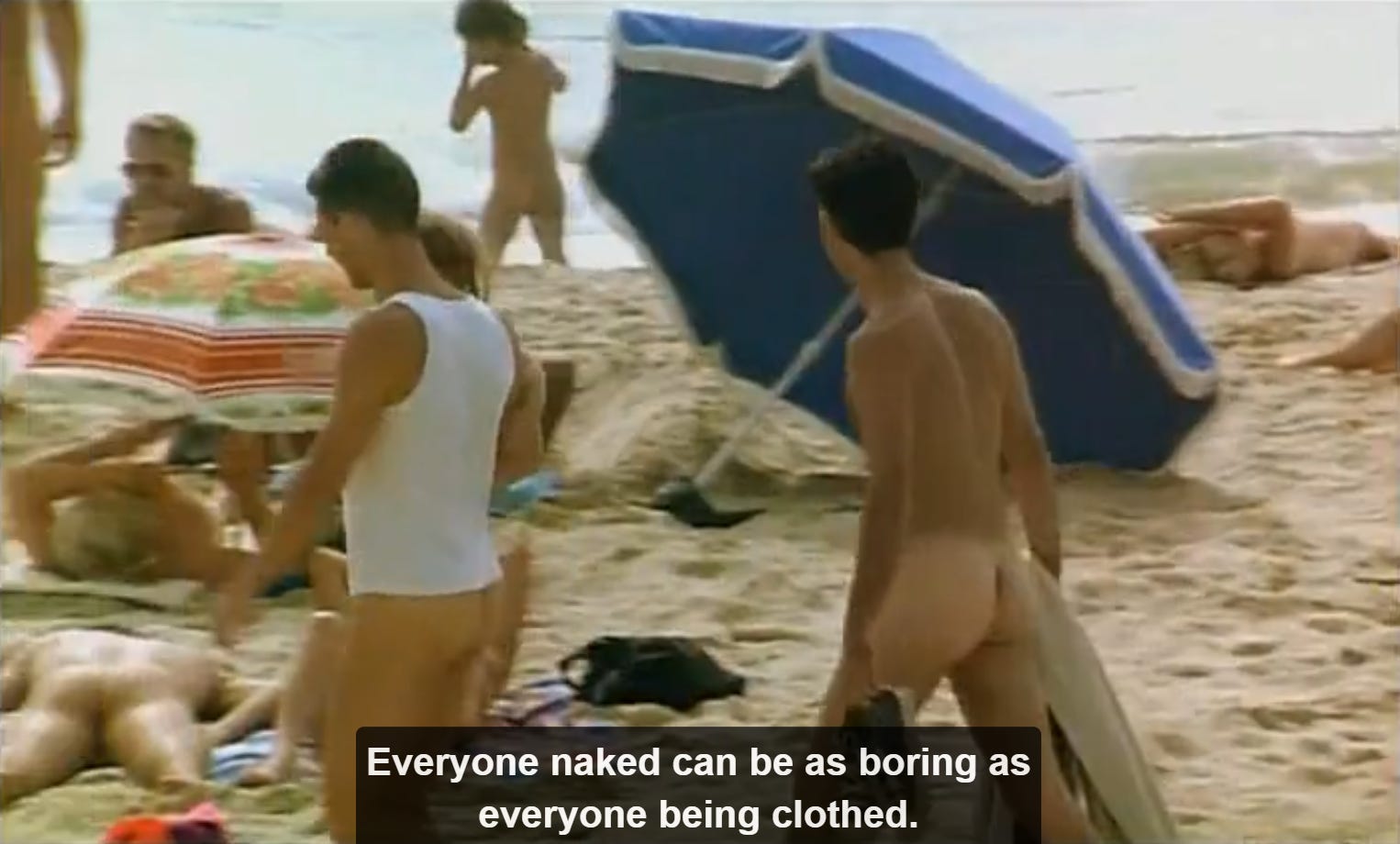
There is so much hope in this documentary, people looking forward to a bright future where nudity is more tolerated and celebrated, and watching it here, now, in 2026, it’s not hard to notice how that hope seems, to me at any rate, almost fully extinguished as more and more people practice nudism in their own homes or have to pay an arm and a leg to go to expensive resorts.
Living Naked is available in various places online for free, including a version without English subtitles on Youtube, but the copy I watched for this review was posted on the Nude Humanity Substack, also available for free, as part of a series called the Nude Vault. 🪐