

The naked witches
A Halloween look at Hans Baldung’s 1510 woodcut
Hans Baldung’s The Witches would make a good Halloween card, provided you didn’t mind explaining the nudity. The cauldron is there, along with a cat and a suitably miserable-looking tree. Above the women gathered on the ground, another woman rides backward on a flying goat. It’s an extravagant scene, and the nakedness is doing some of the work. We’re being shown women who have stepped well outside the rules.
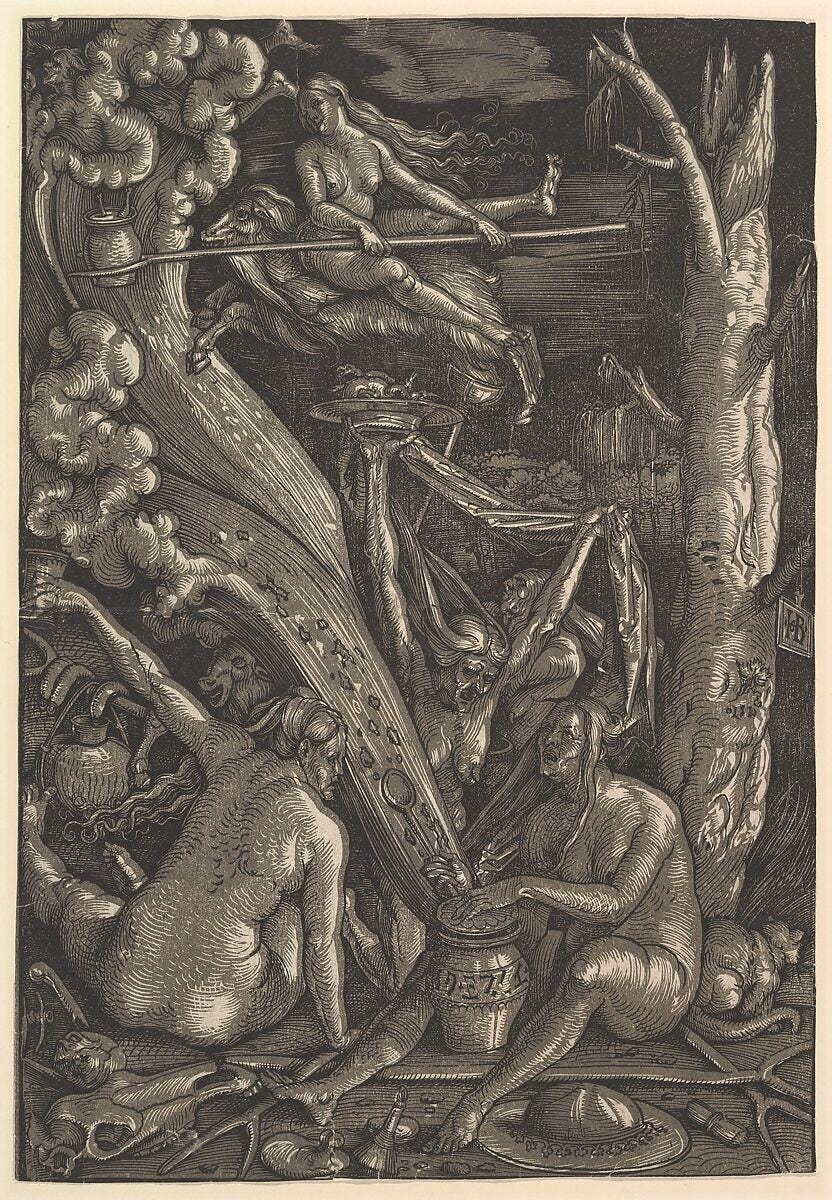
Baldung made the woodcut in 1510. The Metropolitan Museum of Art’s impression, shown here, was printed from two woodblocks in gray and black, with the unprinted paper providing the highlights. That gives the women’s backs and limbs a pale edge against the dark surroundings. The fumes rising from the pot get the same treatment. There’s enough light to make out what’s happening, without making the place look any more inviting.
The woman nearest us has her back turned, one hand planted on the ground. Across from her, another woman tends to the pot, while an older figure raises her arms behind them. Their attention is on whatever they’re doing together. Nobody seems particularly concerned about being seen naked. Put the same bodies in a different setting and there might be little to remark on. Here, the bones scattered underfoot and the activity overhead give the viewer plenty of reasons to be suspicious.
There are also sausages hanging over a fork. That detail deserves an explanation. The Kunsthalle Karlsruhe connects them with the belief that witches could make men impotent, and describes Baldung’s naked, contorted witches as images of unrestrained female sexuality. So the threat goes beyond women taking their clothes off in the woods. These women are imagined as capable of interfering with men’s bodies. The joke has a fairly obvious target.
It’s easy to get carried away with that reading, though. The picture gives us a fantasy about witches; it tells us very little about the lives of women accused of witchcraft. The German Historical Institute is careful to describe it as a record of beliefs about what witches supposedly did. The scene is convincing because of the detail, even when the things it shows are impossible.
There’s also a question about how seriously Baldung expected anyone to take it. Art historian Margaret A. Sullivan has argued that his and Dürer’s early witch pictures make more sense in the context of humanist interest in classical poetry and satire than as direct responses to witch trials. The flying goat and the sausages leave plenty of room for that interpretation. We shouldn’t assume that making a picture of a superstition amounts to endorsing it.
The British Museum’s Feminine Power exhibition likewise read the composition as mocking the macabre, sexualized idea of witches. But the museum also suggested that circulating images like this could reinforce the association between women and witchcraft. That’s a complication worth keeping. A viewer could laugh at the scene and still come away with the same familiar picture of who a witch was supposed to be. Satire doesn’t give an image much control over how people use it.
The interesting part, at least for nudists and naturists, is how much the setting tells us to think about the bodies. The women don’t have to look ashamed or frightened. Their apparent comfort is part of what makes them suspect. They’re naked, gathered together and busy with something the viewer hasn’t been invited into. The picture turns that into a reason to imagine the worst. It’s worth asking how much of that suspicion would survive without the more lurid props.
Paid subscriptions help Planet Nude give nudity in art and culture the attention it deserves. If you value this work, consider becoming a paid member.
As a Halloween picture, The Witches has plenty going for it. There’s a lot to notice before you even get to the nudity, and the more closely you look, the more excessive it becomes. At least the cat has turned its back on the whole business. 🪐