

The Naturism Survey 2026, part one: The state of the movement
2,032 naturists. 99 questions. The largest survey we’ve ever run finds a movement thriving in private and uneasy about its future
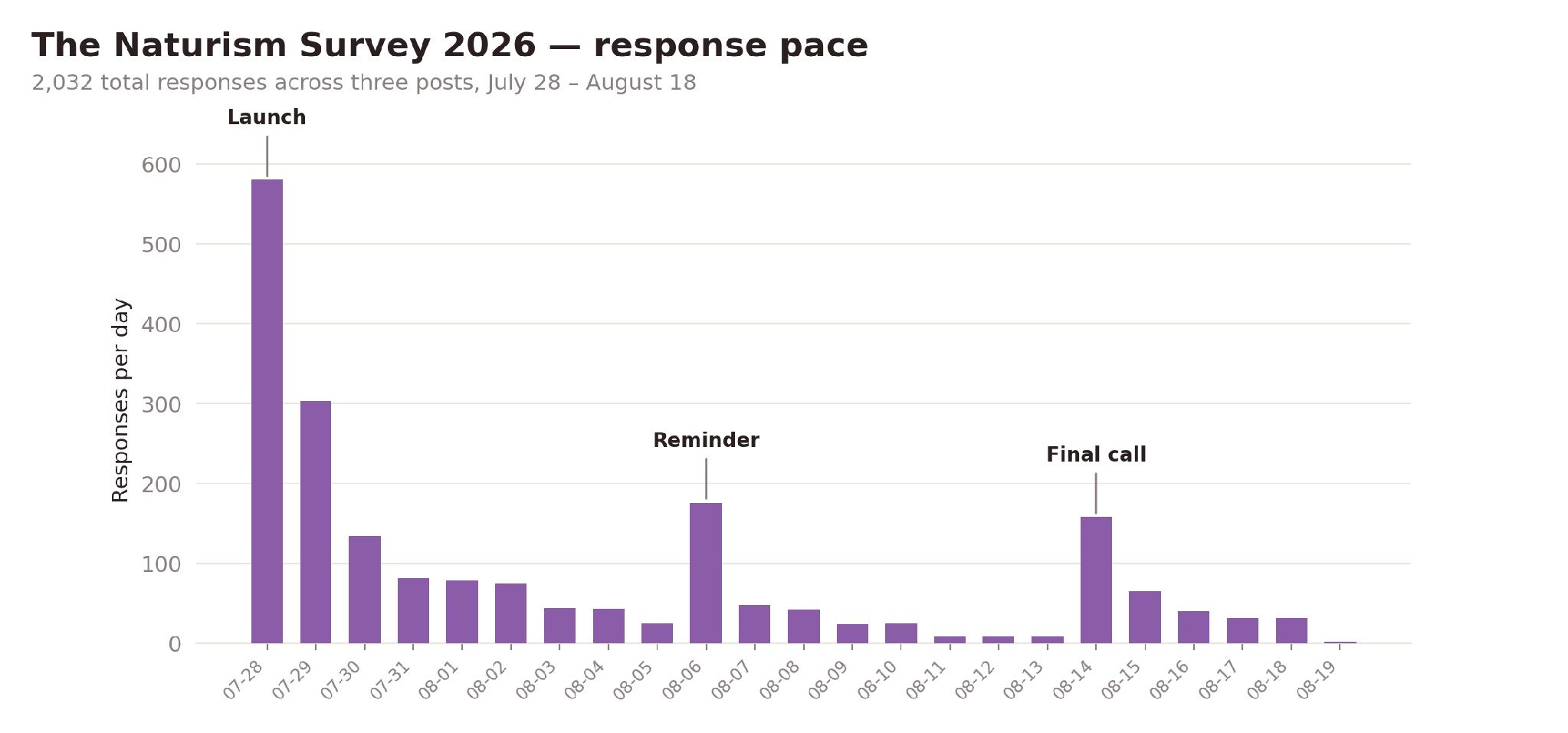
On August 19 we closed the Naturism Survey 2026. It ran for 23 days and drew 2,032 responses to 99 questions. That is more than three times the 600 responses to last year’s reader survey, and it reached well past our own subscriber list. We renamed it from a reader survey to a movement survey on purpose, and clubs, beach communities, and organizations passed it along to people who had never heard of Planet Nude. Thank you to everyone who took it and everyone who shared it.
What came back is a very large amount of information about a community that is rarely studied at all. When we shared the raw results with Mark Pavelchack, the president of the Western Nudist Research Library and a statistician by training, his reaction was that there is enough here for a dissertation. We are not writing one. But we are not going to compress it into a single post either. This is the first of three, publishing on consecutive days this week. Today covers who answered and how the community says it is doing. Tomorrow covers where naturists disagree with each other. The next day’s post covers how people find naturism, what keeps them from it, and what they hope and fear for its future.
Before the numbers, a summary of what they add up to
The people who took this survey are, on almost every personal measure, doing well. They say naturism has improved their lives, their relationship with their bodies, and in many cases their friendships and their marriages. They would recommend it to people they love, and they feel welcome and safe in naturist spaces. That much is close to unanimous.
Almost none of them were raised in it. Two-thirds say social nudity was never normalized in their childhood home, and fewer than one in twenty had parents who took part in organized naturism. This is a movement of converts, and it is practiced mostly in private: two-thirds say most of their nudity happens at home, and more than six in ten say little or none of it takes place in an organized setting. Half of the people who answered have hidden their interest in naturism at some point out of fear of judgment. Among respondents under 35, seven in ten have.
When the questions turn from personal experience to the movement’s institutions, the mood changes. Respondents are unsure whether naturism is becoming more accepted, split evenly on whether organizations are preparing the next generation of leaders, and net negative on whether naturism is attracting younger participants. The people closest to that problem see it most clearly. Respondents under 55 are net negative on every institutional question we asked. Respondents over 65 are net positive on all of them.
The survey also found a community that is close to unanimous about the threats it faces from outside and divided about what it owes the people already inside it. Those divisions run along lines of politics, gender, sexuality, and age, and they are the subject of tomorrow’s post.
A note on what this survey is and is not. It is a self-selected sample of people engaged enough with naturism to find and complete a long questionnaire about it. It is not a random sample of naturists, let alone of the public, and no margin of error applies. Every number in this series describes the people who answered. Every number is also an aggregate. No individual answer is quoted or singled out, consistent with what we promised when we launched. The complete aggregate results for all 99 questions are available as a free download at the end of this post and every post in the series, so you can check our reading against your own.
Who answered
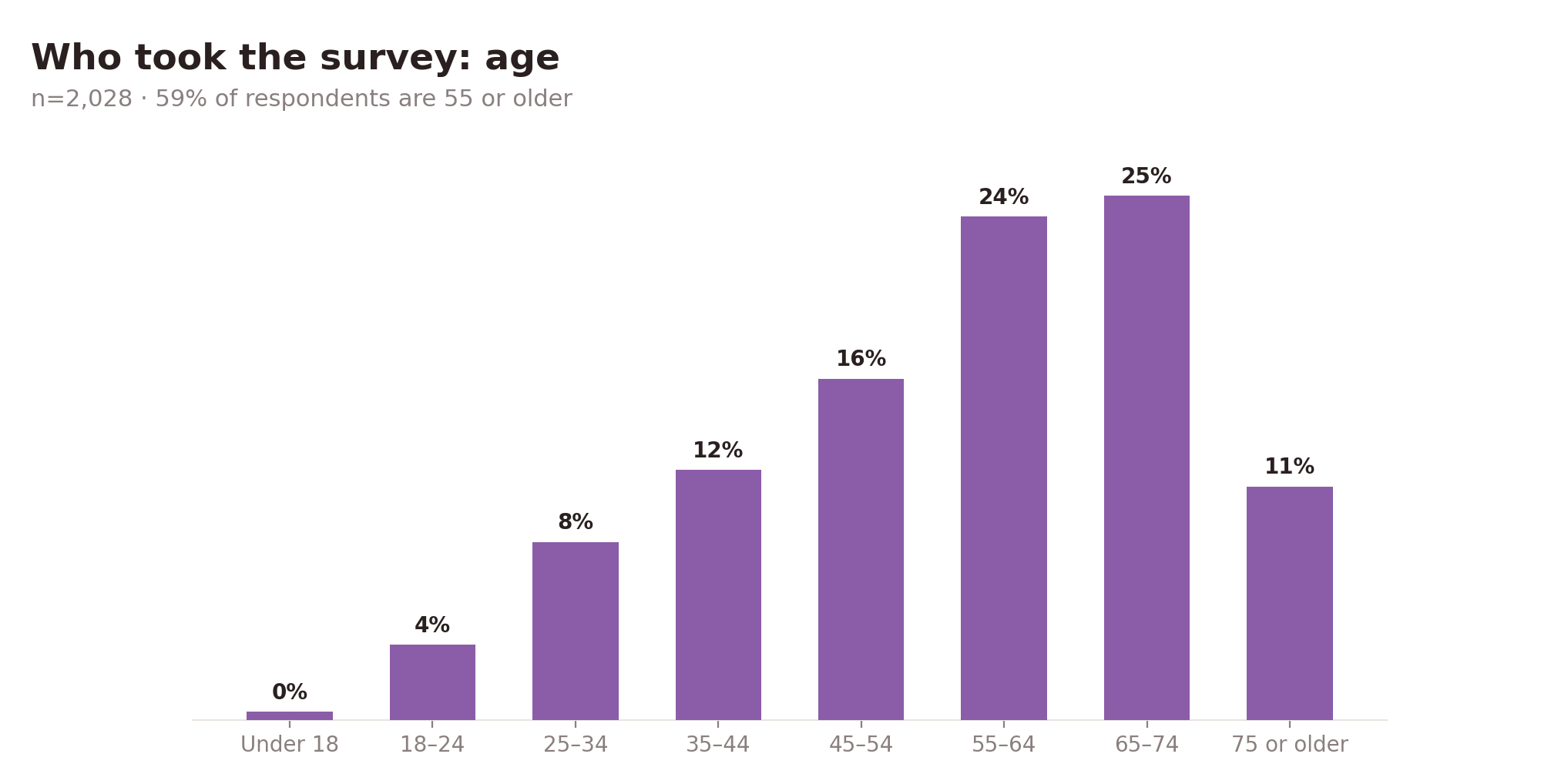
Fifty-nine percent of respondents are 55 or older, and a quarter are 65 to 74. Twelve percent are under 35. Eighty-seven percent identify as cisgender men, 5 percent as cisgender women, and about 3 percent as nonbinary, transgender, or another identity. Eighty-five percent are white. Twenty-two percent identify as LGBTQIA+. Seventy percent live in the United States, with the rest spread across Canada, the United Kingdom, Australia, and 14 other countries. Six in ten hold a bachelor’s degree or higher, and six in ten are married or in a domestic partnership. Forty-three percent describe themselves as Christian, and another 40 percent as atheist, agnostic, or unaffiliated.
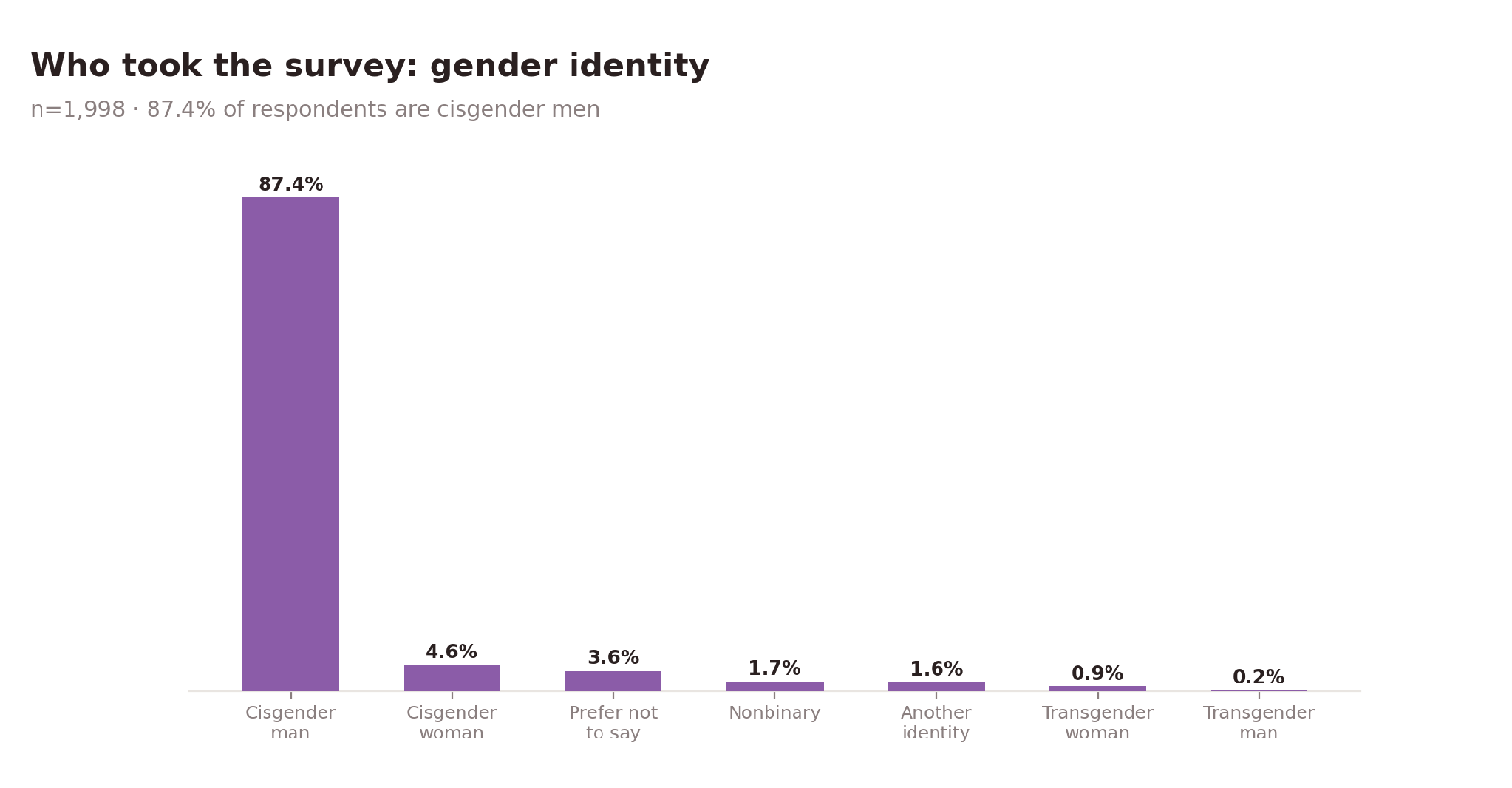
The gender imbalance is the one most people will notice first, and it is real: for every cisgender woman who answered, 19 cisgender men did. But the imbalance is not evenly distributed by age. Among respondents 65 and older, 94 percent are cisgender men. Among respondents under 35, that figure is 81 percent, and women and nonbinary people together make up nearly a fifth of the group. The youngest cohort in this survey is also its most gender-diverse.
That pattern repeats on other measures. Under-35 respondents are twice as likely as the sample as a whole to identify as LGBTQIA+ (45 percent versus 22 percent), more likely to describe their politics as left of center (62 percent versus 45 percent), and far less likely to belong to a club or organization. The people naturism most wants to attract do not look much like the people who currently make up its membership. We will come back to what that means.
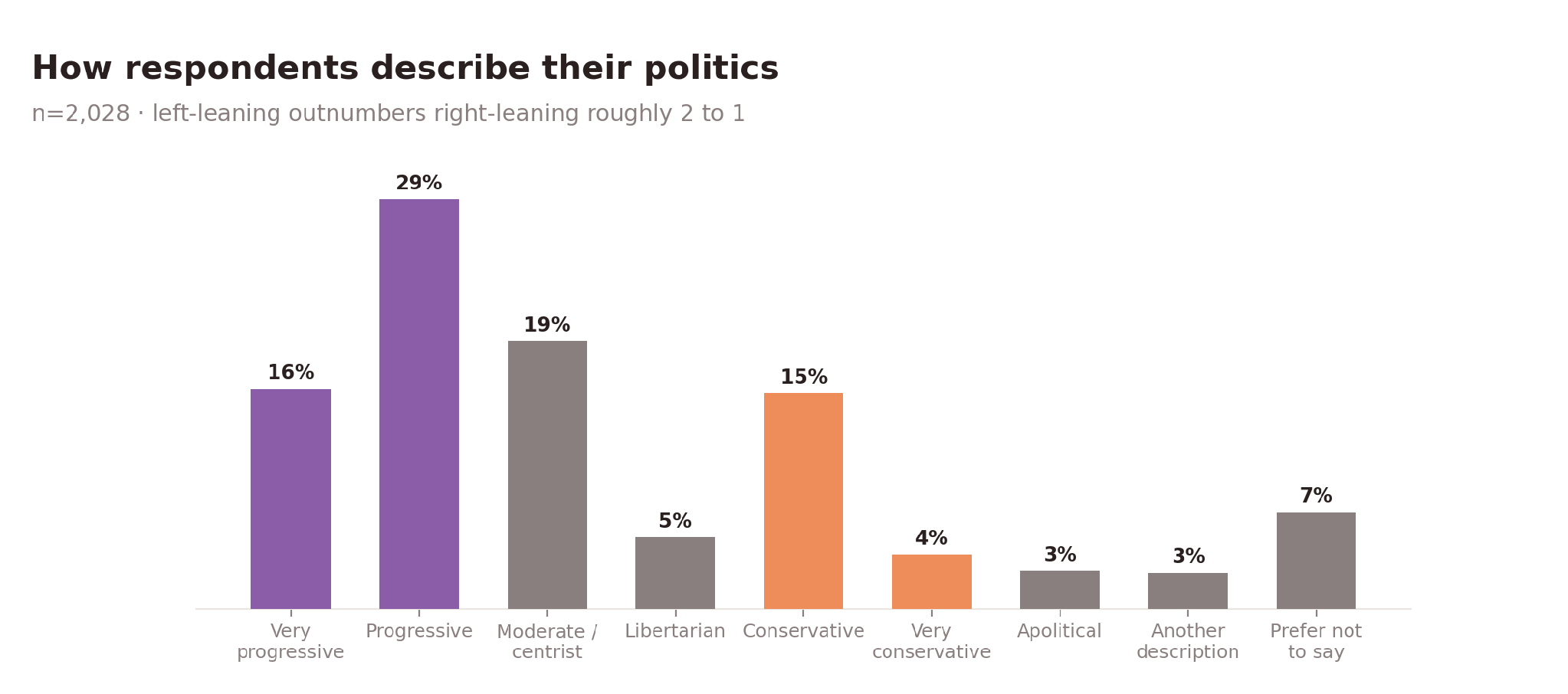
New this year, we asked respondents to describe their politics. Forty-five percent chose one of the two left-leaning options, 19 percent chose conservative or very conservative, and the rest identified as moderate, libertarian, apolitical, or declined to say. Left-leaning respondents outnumber right-leaning ones by a little more than two to one. We asked mainly so that we could test something the comments hinted at last year, and the answer, which takes up much of tomorrow’s post, is that politics predicts responses on inclusion questions better than any other variable we collected.
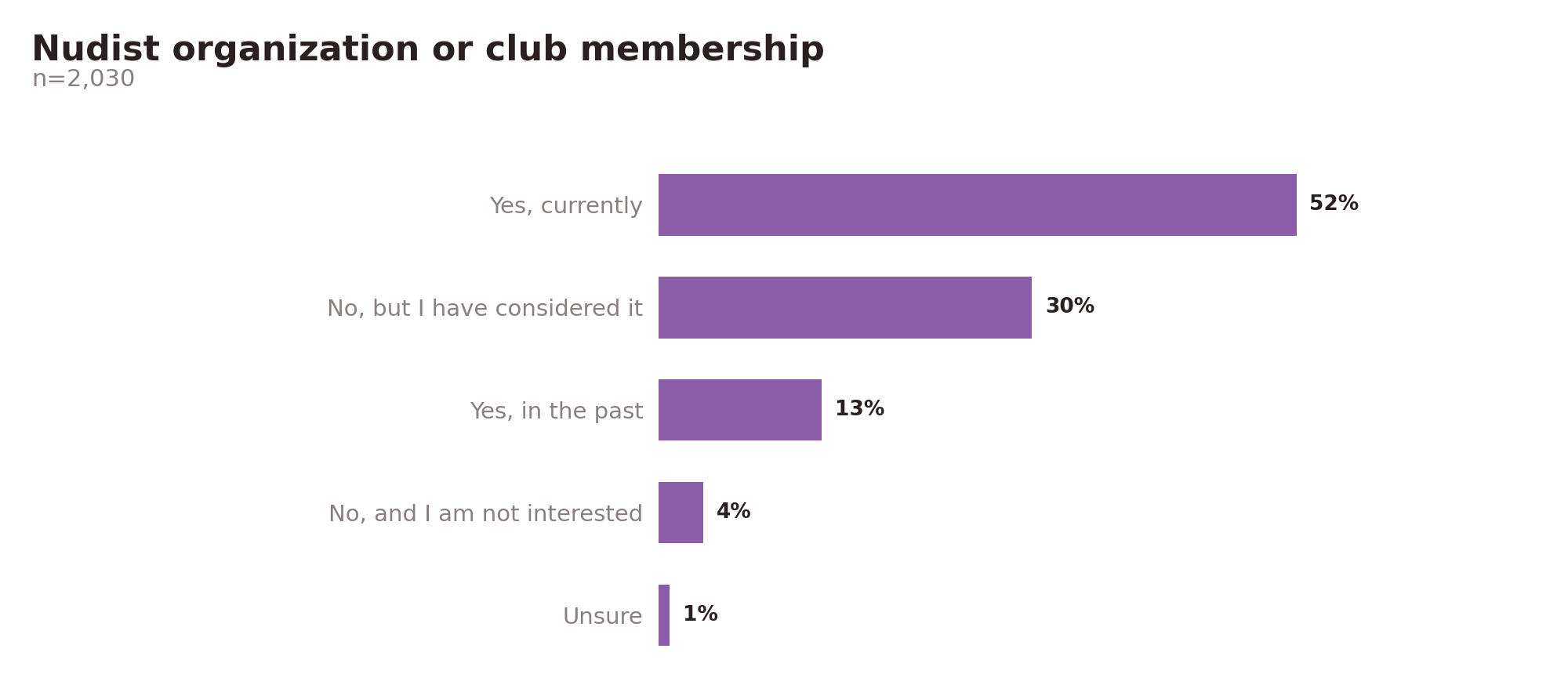
Just over half of respondents currently belong to a nudist organization, club, resort, or meetup group. Another 30 percent say they have considered joining but have not. The age gradient here is steep: 64 percent of respondents 65 and older are current members, compared with 31 percent of those under 35. Among the under-35 group, 58 percent say they have considered membership and not followed through. That is the largest pool of unconverted interest anywhere in the survey.
Where naturism actually happens
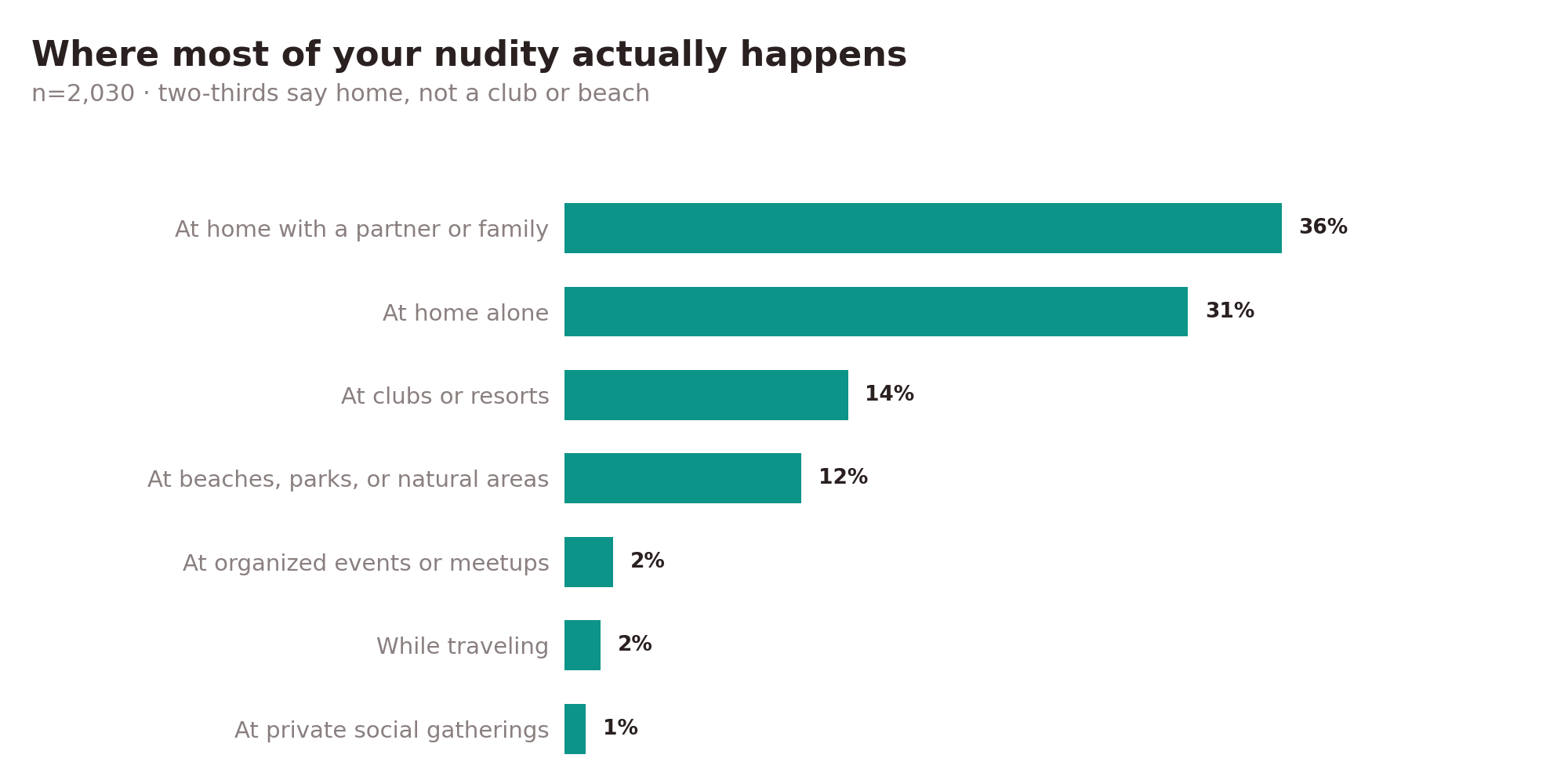
The membership numbers make organized naturism look central to how people practice. The rest of the survey suggests the opposite. Asked where most of their nudity takes place, 36 percent said at home with a partner or family and 31 percent said at home alone. Clubs and resorts account for 14 percent, beaches and natural areas for 12 percent, and organized events for under 3 percent. Asked directly how much of their naturist activity happens in organized settings, 62 percent said a small portion or none of it. That includes half of current club members.
Naturism is also, for this group, a daily practice rather than a vacation activity. Thirty-five percent are nude daily or almost daily, and half are nude at least several times a week. The longer people have practiced, the more often they do: two-thirds of respondents with 40 or more years in naturism are nude daily or several times a week, compared with a third of those in their first three years.
Almost nobody inherited this. Sixty-eight percent say social or casual nudity was never normalized in their childhood home, and 96 percent say their parents did not take part in organized naturism; for nine in ten, the family was not even aware of it. Among people with 40 or more years of experience, 9 percent had parents who participated; among people in their first three years, it is under 1 percent. Whatever intergenerational transmission naturism once had, it is fading. Nearly everyone in this survey found their own way in as an adult, which is one reason the question of how people find it, the subject of part three, matters as much as it does.
Partners are a mixed picture. Forty-six percent say their partner participates, enthusiastically or occasionally. Eighteen percent say their partner is supportive but does not take part. Ten percent say their partner is uncomfortable with it or opposes it. That last figure is 11 percent among cisgender men and 2 percent among women, and it reads the other direction too: 66 percent of women who answered have a partner who participates, compared with 44 percent of men. The gender imbalance in naturism shows up inside relationships before it ever shows up at a club.
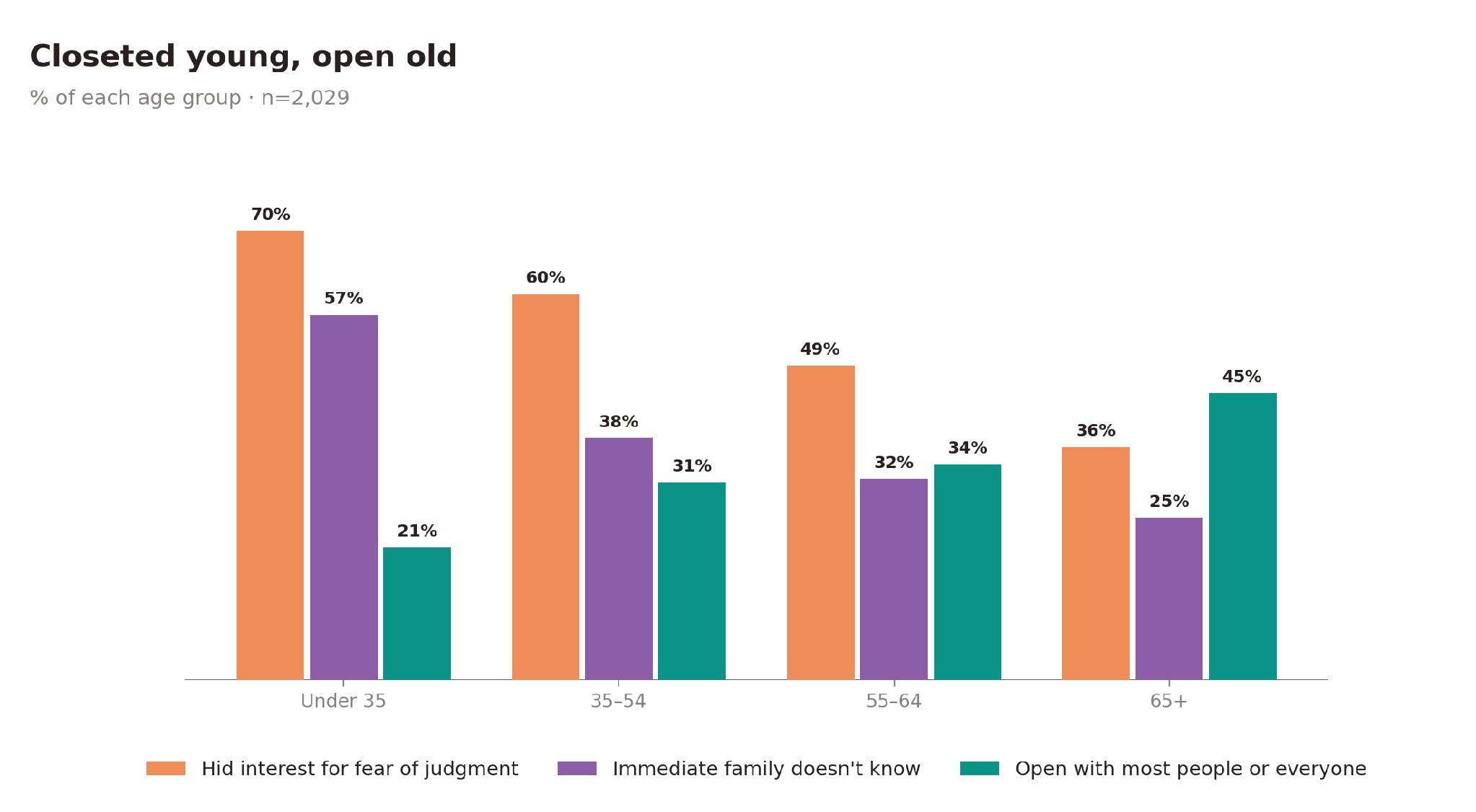
Then there is the question of who knows. A third of respondents say their immediate family does not know they participate in naturism. Half say they have hidden their interest at some point because they feared judgment or consequences. Only 13 percent describe themselves as completely open about it.
Age changes every one of those numbers, and in the same direction. Among respondents under 35, 57 percent say their family does not know and 70 percent have hidden their interest. Among respondents 65 and older, those figures are 25 percent and 37 percent, and 45 percent are open with most people or everyone. Tenure tracks age closely: people in their first three years of naturism are net neutral on whether they feel safe being publicly associated with it, while people with 40 or more years are net positive by 63 points. Part of that is generational, and part of it is that people with jobs and young families have more to lose. Either way, the newest and youngest members of this community are the ones most likely to be practicing it in secret.
The state of naturism, by the numbers
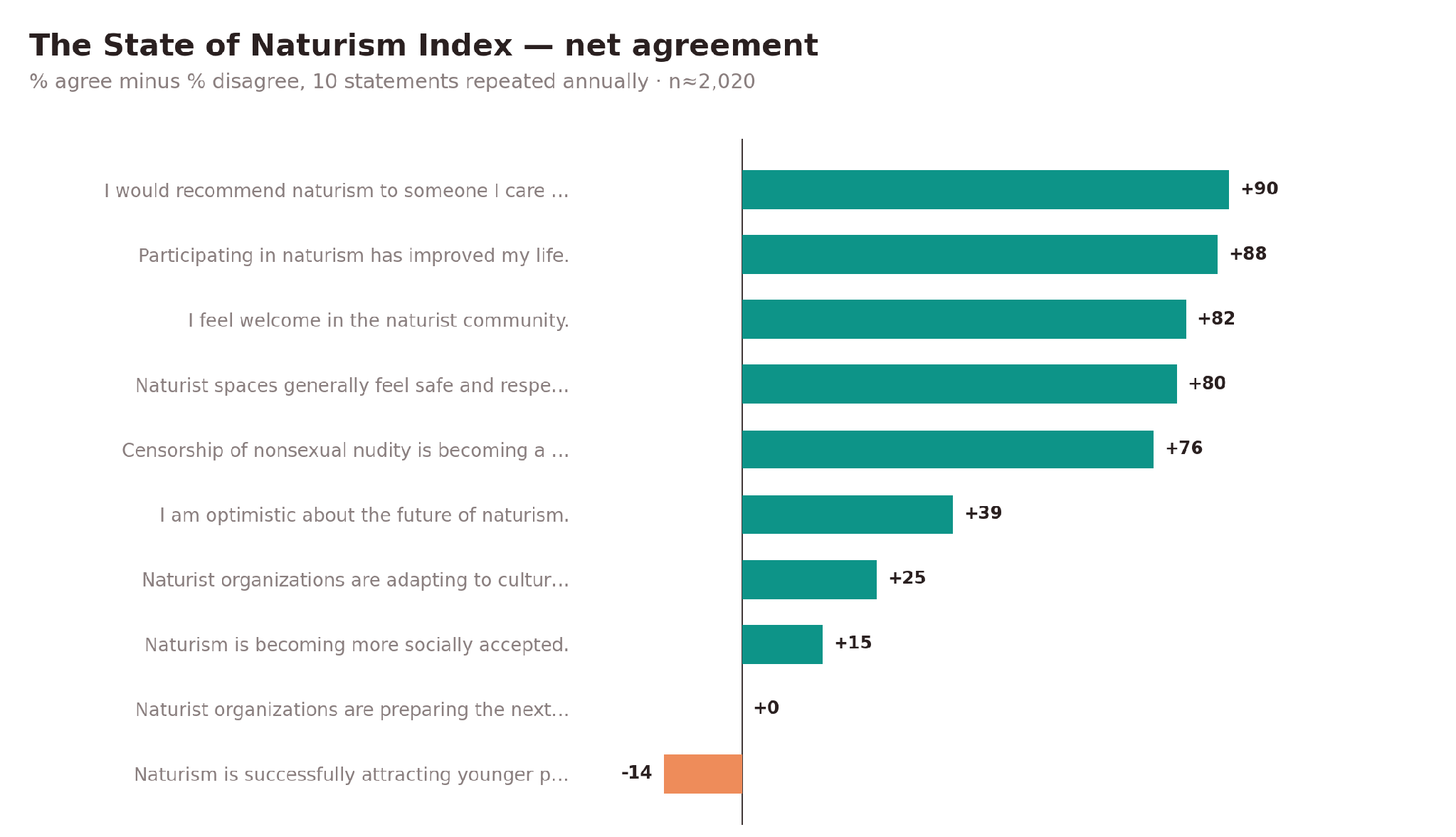
Ten statements in this survey form what we are calling the State of Naturism Index. We intend to ask them, unchanged, every year, so that over time the answers describe a trend rather than a moment. This is the baseline.
On lived experience, the numbers are about as strong as survey numbers get. Ninety-one percent would recommend naturism to someone they care about. Eighty-nine percent say it has improved their life. Eighty-five percent feel welcome in the naturist community, and 83 percent say naturist spaces generally feel safe and respectful. Elsewhere in the survey, 88 percent say naturism has improved their relationship with their body, 78 percent say they have experienced unexpected joy or belonging in a naturist space, and 96 percent say they have never left one feeling worse about their body.
On the movement’s institutions and prospects, the picture is very different. Forty-one percent think naturism is becoming more socially accepted, but 26 percent disagree and a third are unsure. Forty-five percent think naturist organizations are adapting to cultural and technological change, against 20 percent who disagree. Twenty-four percent think organizations are preparing the next generation of leaders, and exactly as many disagree. And 24 percent think naturism is successfully attracting younger participants, against 38 percent who disagree, the only net negative reading on the Index.
The one institutional statement that drew broad agreement was the darkest one: 79 percent agree that censorship of nonsexual nudity is becoming a more serious problem. Only 3 percent disagree.
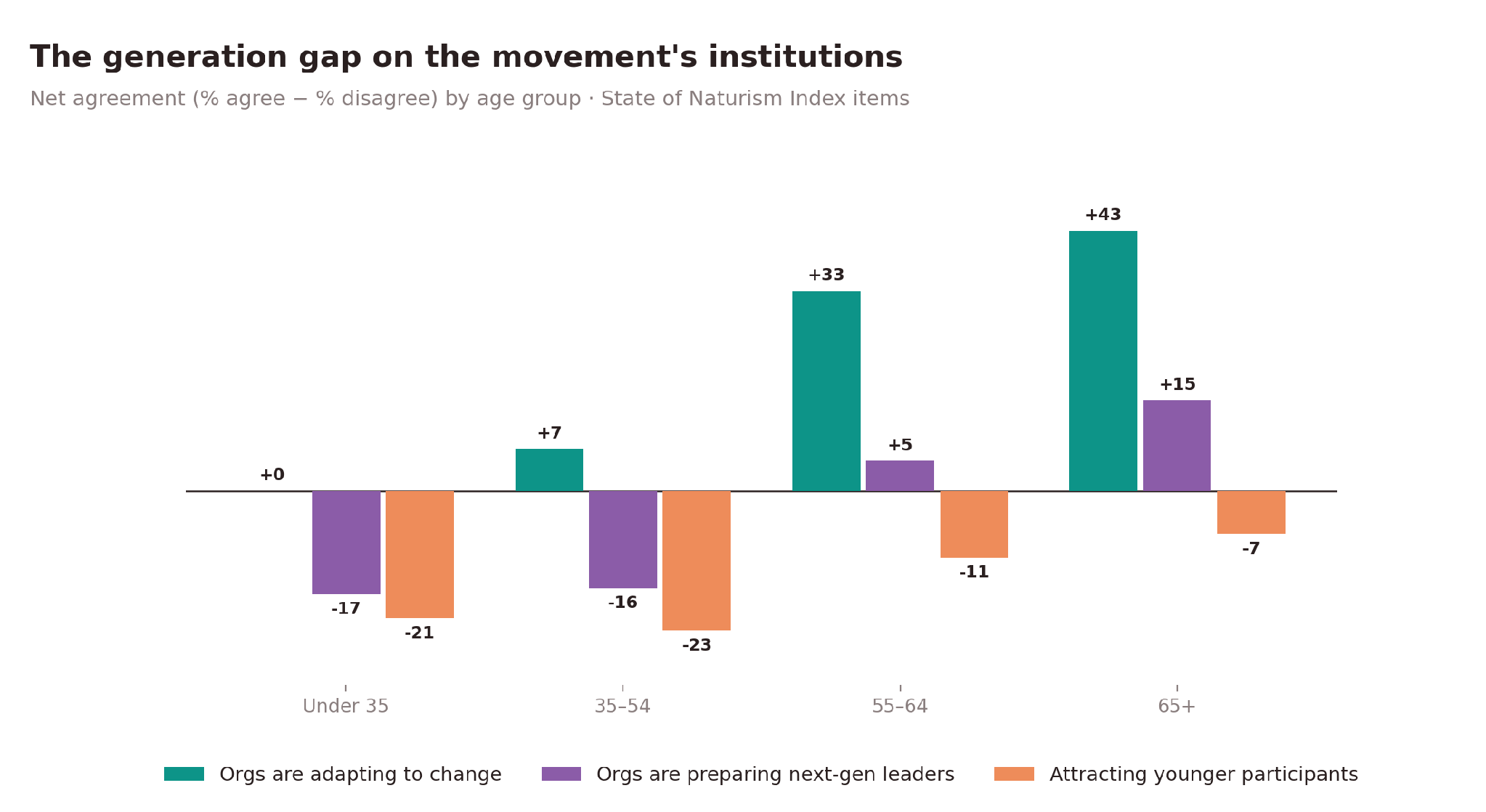
The overall Index numbers conceal a generational split that is the most important single finding in this post. Take the three statements about institutions. Among respondents 65 and older, the view that organizations are adapting to change is net positive by 43 points. Among respondents under 35, it is exactly zero. On whether organizations are preparing the next generation of leaders, respondents over 65 are net positive by 15 points and respondents under 55 are net negative by 16 or 17. On attracting younger participants, every age group is net negative, but the two youngest cohorts are at minus 21 and minus 23, three times as pessimistic as the oldest.
The pattern is consistent: the generation that currently runs most naturist organizations thinks those organizations are doing reasonably well. The generation that would inherit them does not. This is not a difference of a few points. On the leadership question, it is a 32-point gap between the oldest and youngest respondents, and the younger respondents are the ones being described.
The same gap appears, more gently, on the personal statements. Under-35 respondents feel welcome in the community at net plus 66, compared with plus 88 for respondents over 65. They rate naturist spaces as safe and respectful at plus 66 against plus 85. Those are still strongly positive numbers. But they are the lowest of any demographic group we looked at, and they come from the cohort the movement says it most wants to keep.
Membership shapes the Index too. Current club members feel welcome at plus 91 and rate spaces safe at plus 89. People who have considered joining but have not are at plus 72 and plus 68. That is a meaningful difference, and it points in one of two directions: either belonging to a club makes naturism feel more welcoming, or people who already feel welcome are the ones who join. Probably both. What the numbers rule out is the idea that the 30 percent who have considered membership are staying away because they feel the same as members and simply have not gotten around to it.
Two other splits worth noting. Respondents outside the United States are noticeably more optimistic than Americans: net plus 26 on naturism becoming more accepted, versus plus 10 in the US, and plus 48 on the future of naturism versus plus 35. And left-leaning respondents are more pessimistic than right-leaning ones on nearly every institutional item, including social acceptance (plus 7 versus plus 19) and optimism about the future (plus 31 versus plus 45). The censorship statement is the exception: there, left, center, and right agree within a few points of each other.
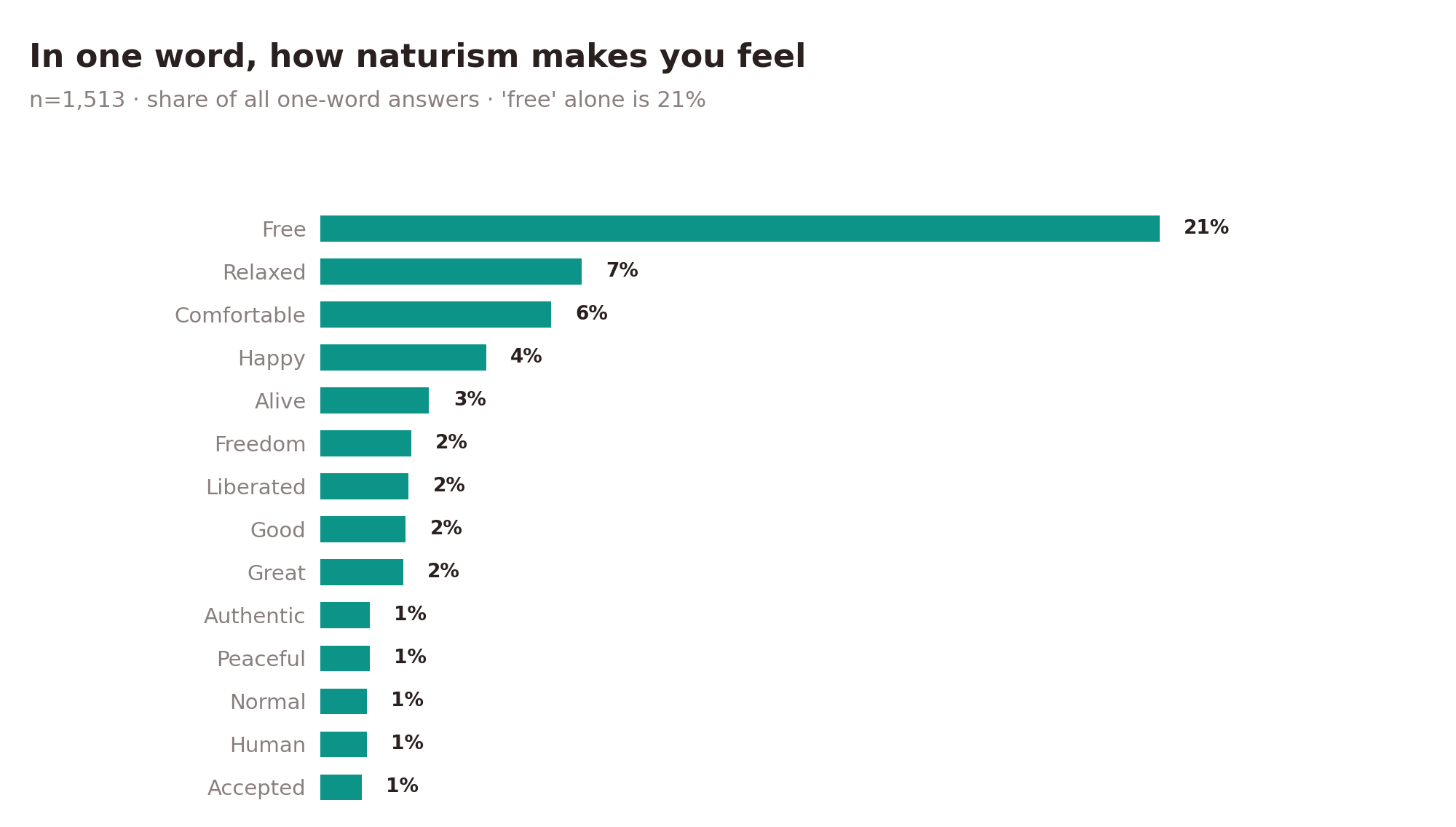
We closed the survey by asking people to describe, in one word or phrase, how naturism makes them feel. 1,513 people answered. One word in five was “free,” and if you add “freedom” and “liberated,” a quarter of all answers were some version of the same idea. “Relaxed,” “comfortable,” “happy,” “alive,” “peaceful,” “normal,” “authentic,” and “accepted” fill out the rest of the top of the list. Nobody was prompted with options. That is the vocabulary people reached for on their own.
Set that next to the institutional numbers and you have the shape of this year’s results. Naturism, as an experience, is working for the people who practice it. Naturism, as a movement with organizations, leaders, and a future to plan for, is something they are far less sure about. And the people most uncertain are the ones the movement would need in order to have a future at all.
What comes next
Tomorrow, part two: the gap between what naturists say they believe and what they do about it, who this community trusts for information and who it does not, and the specific places where left and right, men and women, and straight and queer respondents part ways on what the movement should be. Friday, part three: how people found naturism, what stands between them and more of it, what they fear if their naturism became known, and what they hope and worry about for its future.
If you would rather not wait, the complete aggregate results are available now as a free download: every question, every answer option, exact percentages and counts, with a methodology section describing how the survey was fielded and what its limits are. No individual responses are included.
Thank you again to everyone who took this and everyone who put it in front of someone who otherwise never would have seen it. That is the only reason this dataset exists. 🪐