

Three days in Hungary
Back at the table at the INF-FNI World Congress
Two years ago, I stood before the International Naturist Federation’s World Congress in Zipolite, Mexico, and spoke about AANR’s interest in returning to the international organization. A proposed change to the membership rules had just fallen narrowly short of the support it needed. There was plenty of goodwill, but no clear way forward.
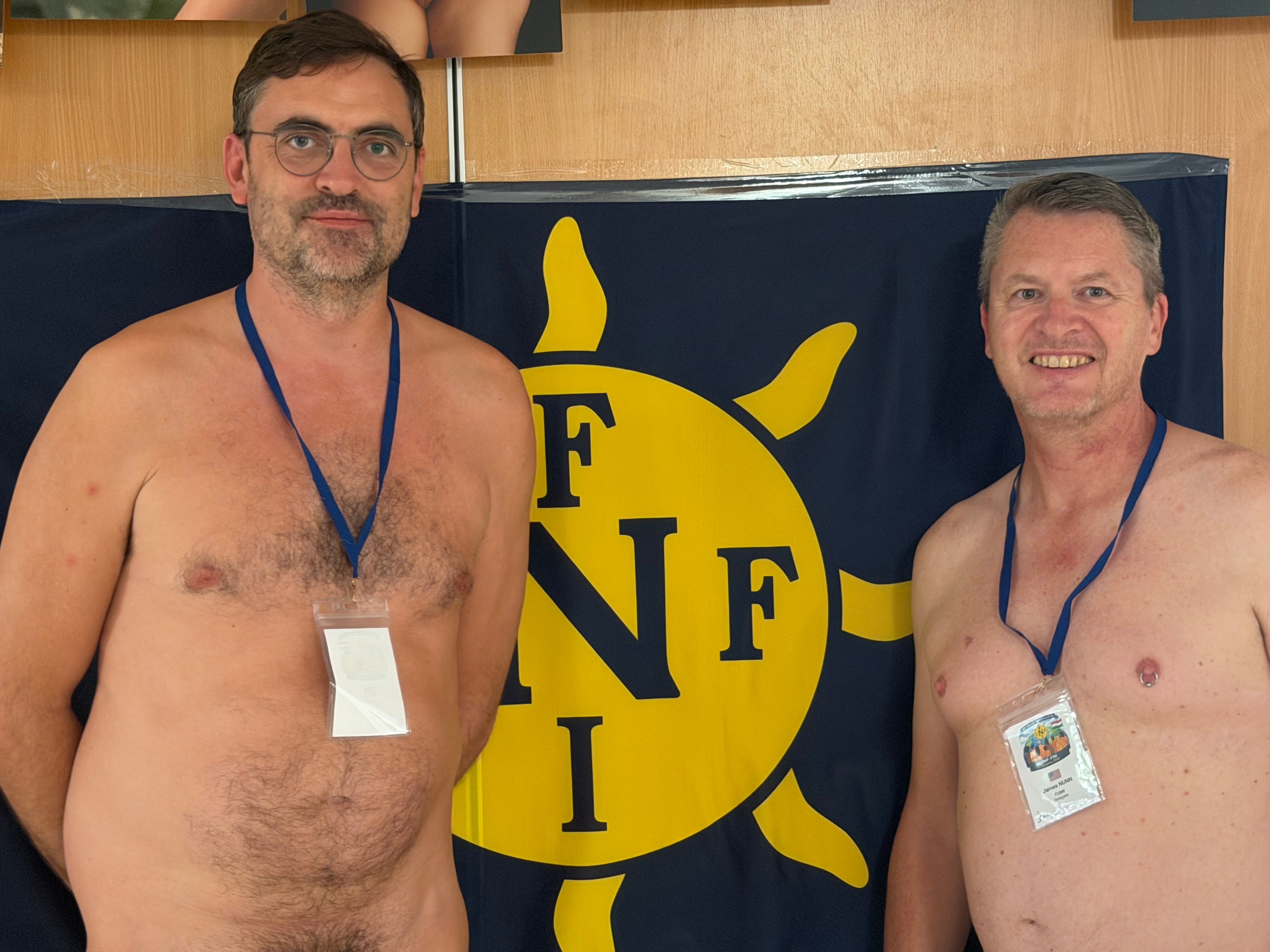
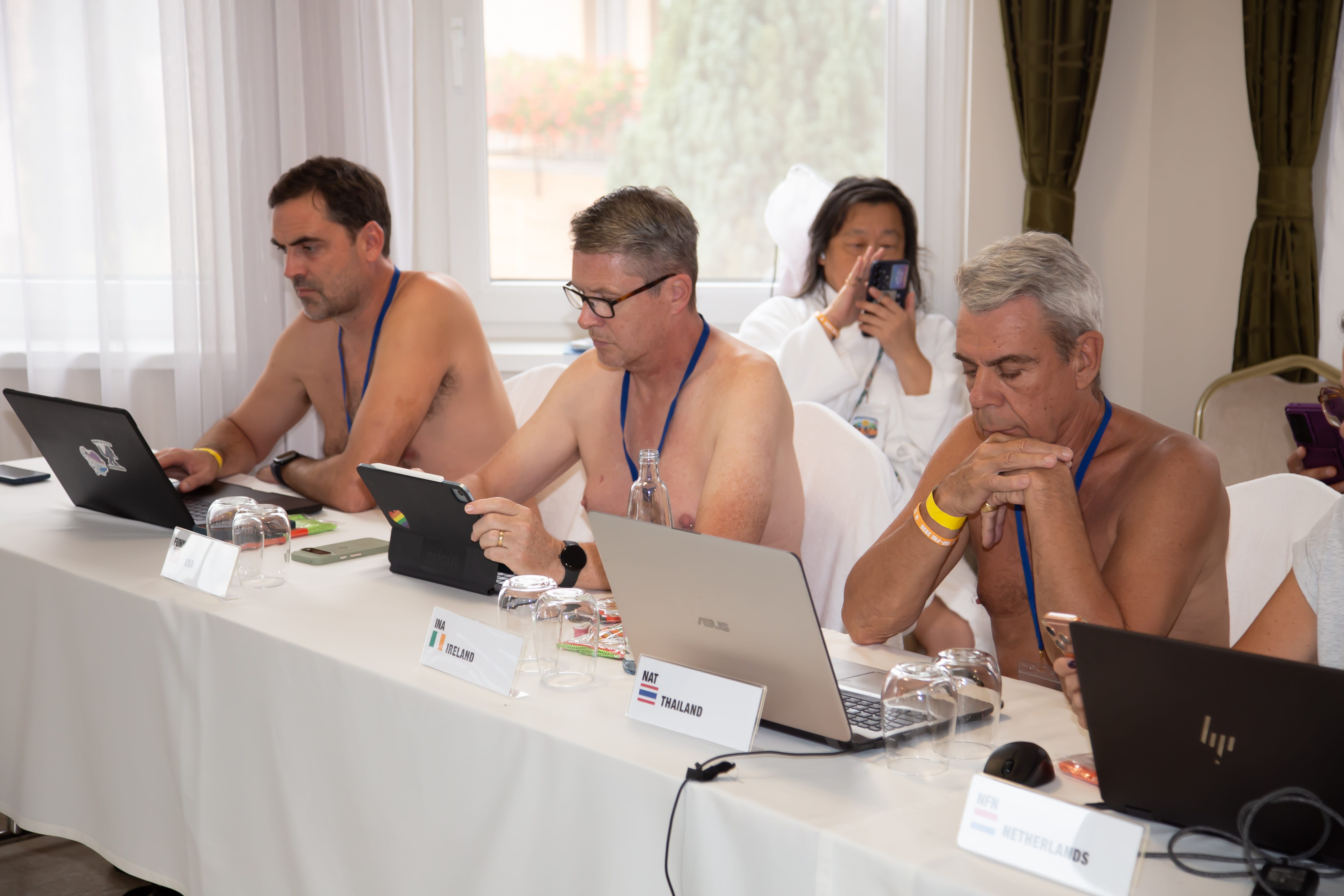
This September, I returned to Congress under rather different circumstances. My colleague and fellow founding board member James Nunn and I were there to represent FUNN, our new American federation, which had launched on August 11. Six weeks later, we were introducing ourselves to delegates from around the world and casting our first votes.
The 40th INF-FNI World Congress took place September 24–26 at the Granada Wellness Hotel outside Kecskemét, Hungary. The setting was a considerable departure from the open-air palapa, wandering chickens, and Pacific surf of Zipolite. Granada is a conventional hotel with lovely grounds, meeting facilities, and a pool and spa. It is not ordinarily a naturist property, and for most of the Congress, nudity was confined to our second-floor meeting area.
Still, some things were familiar: long discussions about statutes, generous meals, people switching between languages, and mosquitoes that apparently remembered me from Mexico.
I attended as a FUNN co-founder and voting delegate, so this account comes with that involvement plainly attached. We have prepared a separate report for FUNN members detailing our votes. What follows is my own account of the business, the conversations, and what it felt like to return.
Why we were there
For readers unfamiliar with it, the INF-FNI brings together national naturist federations and other affiliated organizations. Its Congress meets every two years to make decisions about membership, finances, policy, and international cooperation. Much of the work is procedural, but the rules determine who gets to participate and what the organization can accomplish.
The United States has a complicated history here. The American Association for Nude Recreation left following disagreements that included the cost of paying INF-FNI dues on its entire membership. Efforts to find a workable route back have repeatedly encountered the question of whether international affiliation could be optional for individual AANR members.
In Zipolite, proposed flexibility came tantalizingly close to passing. As I reported at the time, the final vote reached about 65 percent, just short of the required two-thirds majority. I left encouraged by the conversations and disappointed by the result.
FUNN grew out of years of discussing how Americans who wanted international participation might obtain it. James and I have experience with the existing American organizations, and we hope to cooperate with both AANR and The Naturist Society Foundation. Formal partnership discussions are still ahead of us. In the meantime, we felt there was work we could begin.
One reason to begin now was on this Congress’s agenda: a proposed international survey of public attitudes toward naturism and nude recreation.
A global picture of naturism would be incomplete without the United States. We wanted to be there to say so.
Counting more than memberships
Congress approved the proposed Ipsos survey by 131 weighted votes to 34, with one abstention. FUNN voted in favor.
This was, to my mind, among the most promising decisions of the meeting. We spend a great deal of time in organized naturism discussing membership figures. Those figures matter, but they tell us about the people who join our organizations. They tell us much less about everyone else who swims naked, visits a nude beach, enjoys a sauna, or otherwise participates without adopting the label or paying annual dues.
Comparable research across countries could help us understand how widespread these experiences are and how people feel about them. It could also give organizations better information for advocacy and public communication. Separate national surveys are useful, but comparing them can be difficult when their questions and methods differ.
During the financial discussion, delegates heard that €50,000 had already been reserved for the research, with another €10,000 included in the budget. Approval was an important step, although the final country list, timetable, and arrangements still need to be settled. American inclusion is something we will continue to follow up on.
Congress also passed a proposal from the Malaysia Nature Wellness Society to make information about the INF-FNI’s research fund more accessible, including its purpose, eligibility requirements, application process, and contacts. This is less exciting than announcing a worldwide survey, perhaps, but a fund is of limited use to people who cannot find out how to apply.
The business of belonging
Several motions addressed the membership framework itself.
One clarified the relationship between the INF-FNI, its member federations, and the individuals who belong to those federations. It bases federation dues on adult membership and explicitly recognizes both physical and electronic INF-FNI stamps. The proposal was presented as a clarification intended to preserve practical benefits and the existing weighted voting system.
Another amendment explicitly allows regional and international groupings of naturist organizations to become associate members. Both passed, along with corrections to drafting errors in the statutes.
A separate Malaysian proposal sought a review of federation recognition procedures while retaining the one-federation-per-country framework. FUNN supported it, but it was defeated.
Before traveling, we had circulated the motions to FUNN members and asked for their preferences. We received 118 counted ballots, with majorities supporting all eight original proposals. That consultation informed our voting, although it also left us responsible for listening to the discussion in the room.
The occasion on which we departed from the member preference concerned a proposal from FENAIT, the Italian naturist federation, to petition the European Parliament for a directive harmonizing laws on naturism and recreational nudity across EU countries.
The discussion was spirited and split, particularly among European federations. A Central Committee amendment proposed a different approach: asking Parliament to examine the cross-border effects of differing laws and consider action within its powers.
After hearing the discussion, James and I chose to abstain on both the amendment and the original motion. Our members had favored the original proposal, so that decision requires an explanation. We felt that, with European federations themselves divided over how to approach an issue primarily concerning the EU, our new American delegation should refrain from taking a side.
Both proposals were defeated. The amendment lost by just two weighted votes, 74 to 76, with 16 abstentions.
These are weighted totals, incidentally, rather than counts of people in the room. That distinction can make a substantial difference to how a result looks.
Introducing FUNN
Our Friday presentation went well, though it was followed by enough questions that more than one person later described the experience as getting the “third degree.”
I understood much of the curiosity. Everyone seemed to know AANR. FUNN was unfamiliar, and our small, focused organization looks different from federations that represent clubs, run facilities, or organize events.
We were asked about our policies, our plans, and who we intended to serve. Questions about our low price carried a concern that members of other federations might eventually join FUNN instead. We explained that membership is currently open to US citizens and residents, and that our attention is on serving that community.
Our minimum membership age of 18 also prompted questions about whether we supported family naturism. We assured delegates that we do. FUNN’s membership is organized around international affiliation, representation, and diplomacy. Children do not participate in INF-FNI voting, and we have not created a separate child-membership category. That says nothing about whether families belong in naturism, a point I would have thought my own enthusiasm for family naturism made fairly clear.
We were also asked whether we planned to hold events in the United States. We have no current plans to do so.
Taken together, the questions showed how much explaining we still have to do. For delegates accustomed to a federation providing a broad range of domestic services, an organization built primarily to connect Americans to the INF-FNI requires a little reorientation.
We received many warm welcomes. We also encountered reservations. Both belong in an honest account of our first Congress.
Some unfinished politics
Two further proposals were circulated for possible consideration at an extraordinary assembly. Neither was adopted in Hungary.
The first, jointly submitted by eight federations, would require General Assembly approval of new member federations referred to it by the Central Committee. At present, the committee can approve admissions itself.
I do not find that proposal unreasonable. Giving the wider membership a say is a legitimate check on the committee’s authority, and I could see FUNN supporting it after reviewing the details. Still, coming after our admission and the close questioning of our organization, the timing was noticeable.
The second proposal, from the Naturist Association Thailand, would allow multiple federations representing defined territories within countries with more than 250 million inhabitants. Although it named several populous countries, the United States was the immediate practical case among the countries represented in the INF-FNI.
There are fair questions to ask about that distinction. A country’s population is not the same thing as its organized naturist membership. FUNN represents a very small number of people in a very large country. There are also practical problems with dividing representation geographically when organizations such as FUNN and AANR already serve members nationwide.
I found myself wondering how the proposal would be received if its population threshold included more of the federations sitting around the tables.
I cannot account for every delegate’s motives. But being American was part of the context of these conversations, and it would be evasive to pretend otherwise. The United States is large, its history with the INF-FNI is complicated, and a new organization arrives without the familiarity that older federations enjoy. At times, the questions seemed concerned as much with what an American federation might eventually become as with what FUNN actually is.
We should be able to discuss that without turning it into a quarrel. We will have the opportunity to debate the proposals on their merits, and other federations should expect us to ask the same careful questions they asked of us.
I also enjoyed meeting people from these countries. Disagreement about a statute did not prevent a good conversation over dinner.
Keeping the organization running
Congress adopted the 2027 budget by 121 weighted votes to 24, with 20 abstentions. It includes a projected deficit, with discussion focusing particularly on an allowance for modernizing the accounting operation.
The existing arrangements depend heavily on one person and an older system. Moving records into an online system that several people can use, with appropriate specialist help, is an understandable priority. The €37,000 allowance discussed was an estimate for that work rather than an agreed contract price.
Marcus Hauss was elected treasurer in the only contested election, defeating Michel Imbert by 94 votes to 72. Edwin Kilby was elected vice-president and secretary without opposition, as were Christo Bothma for Africa and Asia-Pacific, Marc van Echepoel for the Americas, Hervé Begeot as president of the Law Council, and Henri Hermans as auditor.
Delegates also approved further investigation of Belgium as the INF-FNI’s legal home. This was permission to investigate and return with a proposal, not an immediate move. The operational office was envisaged as remaining in Austria.
Beyond the votes, there were useful discussions about recruiting volunteers for specific jobs, sharing knowledge, and matching organizations that need help with people who have relevant experience. Women’s participation and family naturism were among the areas discussed. These efforts will depend on people following through after everyone gets home, but they offer practical ways for a small federation to contribute.
Between sessions
Our hosts, the Federation of Naturists in Hungary, had arranged a full social program alongside the meetings. The meals were delightful, and sitting down together over lunch and dinner gave us time to continue conversations, meet people from other delegations, and talk about something besides the statutes.
Granada was still operating as a conventional hotel, which gave the gathering a particular look. Robes were everywhere as delegates moved around the property, covering up between the places where we could be nude. It was a different arrangement from Zipolite, where the beach and the Congress flowed into one another. Here, we were making a temporary home for naturism inside a hotel that ordinarily expected its guests to stay dressed.
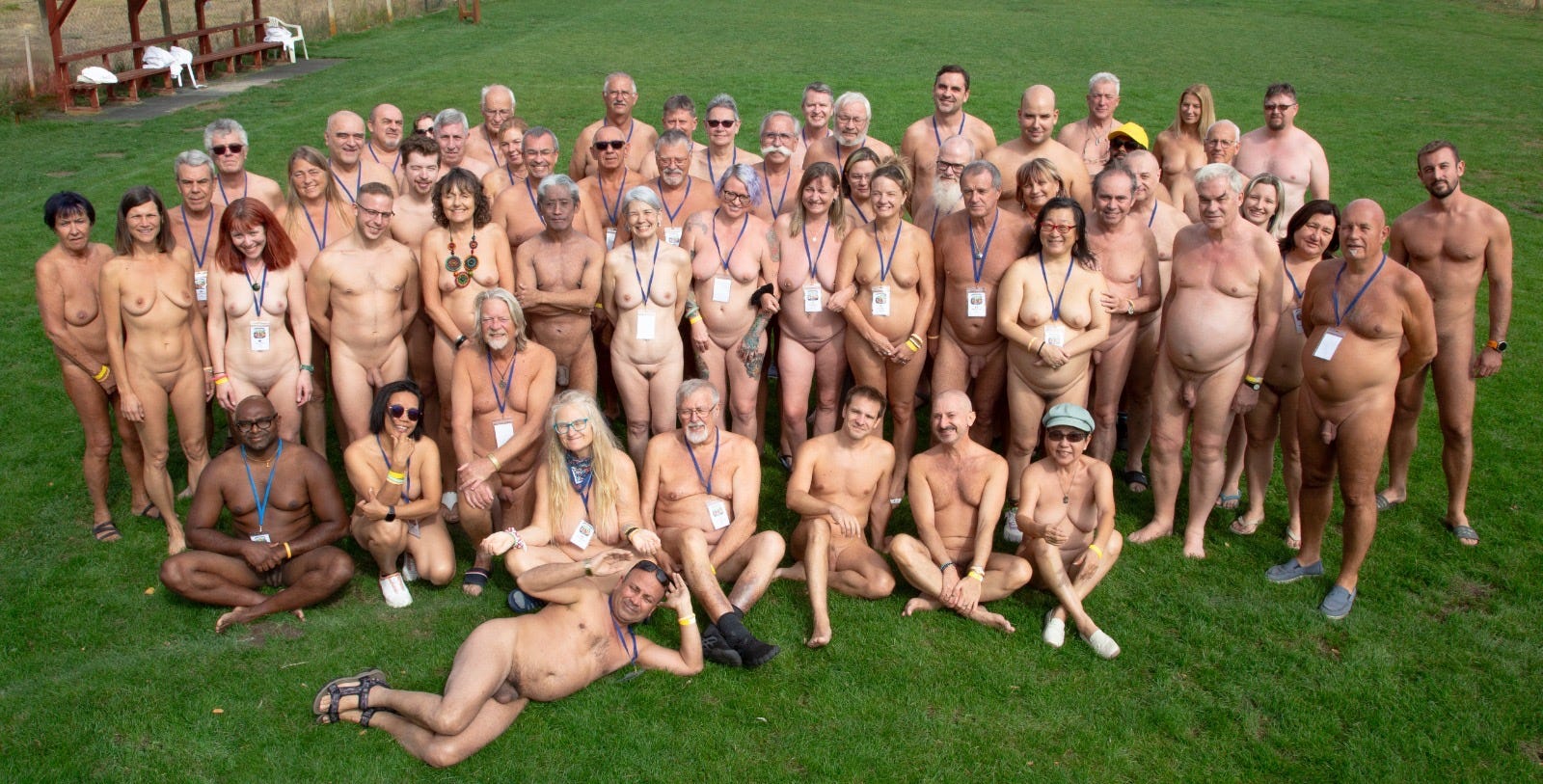
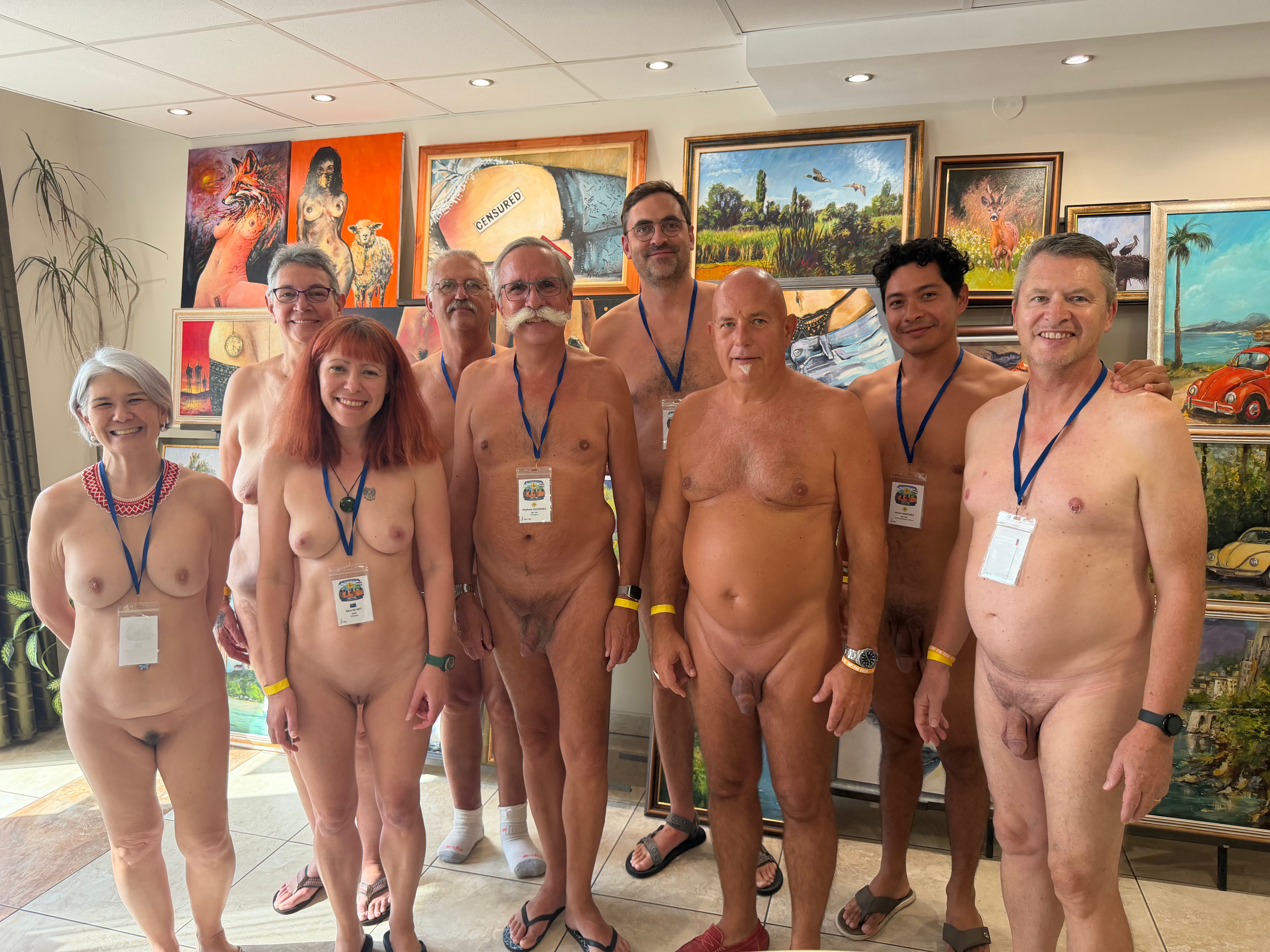
On Thursday, we gathered on the football pitch for the large nude group photograph. That evening brought a film screening, and local artists also presented their work during the Congress. There was plenty to see and do once the official business finished for the day.
Friday evening, we took over the pool and spa for a naturist session. After spending so much of our nude time sitting in meeting rooms, I particularly enjoyed being able to get into the warm water of the extra-large jacuzzi. A wellness hotel makes a rather good setting for a naturist gathering when you can actually use the wellness facilities nude.
Saturday night ended with a disco dance party. After three days of presentations, questions, and voting, it was a welcome change of activity—and another chance to spend time together (and get a lieelt wild) before we all headed home.
One of the great pleasures of Congress is the range of people you meet. There are cultures and experiences gathered here that I have not encountered together anywhere else in naturism.
One of the more incredible moments came when I met an American who has lived in northern Europe for the past twenty years. As we talked, we discovered that he had grown up in Boulder City, Nevada, where I live now—and that he still owns a home on my street. He remembered my dad, and I remembered his mom. Somehow, we had traveled very different paths to end up at a naturist congress in Hungary, discovering that connection over a conversation. I’ll leave his name and adopted country out for his privacy, but I’m still shaking my head at the coincidence.
The mosquitoes, unfortunately, required no such introduction. I counted more than 30 bites and killed more than 20 in our room. There is probably a joke to be made about mosquitoes at a nudist conference. By Saturday, I was not especially interested in finding it.
I left Hungary encouraged by the research decision, grateful for the hospitality, and aware that FUNN has plenty of explaining and learning ahead. We had introduced ourselves, voted, answered questions, and begun getting to know the people we will be working with.
In Zipolite, I spoke about finding a way for Americans to return to the table. This time, James and I had seats there. What we do with them is the work ahead. 🪐